Dr. Sandy D. Womack Jr. has spent his first months as superintendent of Twinsburg City↗ET doing what he says he came to do first: listening. He confirmed in written answers to The OHEdTribune that his first official day with the district was Aug. 1, 2026.
"My first leadership priority is to listen, learn, and meet internal and external community stakeholders where they are to understand what they want to see for the future of our Twinsburg City School students," Womack wrote.
He arrives with ideas of his own and says they can wait for the community's answer. "I have great ideas for project-based instruction, alumni development, increasing CCP offerings, business partnership goals, etc., but I need to understand what the community needs, goals, wants, and desires are for the schools they are sending their children to."
A Northeast Ohio return
Womack described himself as a native of the region. "I am from Northeast Ohio," he wrote. "I served in Cleveland Heights-University Heights and the Akron and Cleveland Public Schools, so the rich tradition of academic excellence and award-winning extracurricular programs stood out and drew me to the community, with its beautiful homes, several parks, and proximity to Akron and Cleveland."
His career has also run through central Ohio. In 2021, Ideastream reported that Womack, then an area superintendent in Columbus City Schools, was one of two finalists for the superintendency of Akron Public Schools, the district he graduated from and where he began his career teaching.
Asked what drew him to Twinsburg, he started with the place and its people. "My interest in Twinsburg was sparked by the community, diversity, academic legacy, and the people who supported my candidacy during the interview and hiring process."
The seat had been in transition for a year. Kathryn Powers retired as superintendent effective July 1, 2025, Nordonia Hills News reported. Michael Sedlak, the district's human resources director, stepped in as temporary interim superintendent, and the school board said it would work with the Educational Service Center of Northeast Ohio on an interim appointment "to help lead the district during the search for a permanent replacement."
"WE can accomplish far more than ME"
Womack framed this job as a different chapter from the ones before it. "I want the community to understand that, in this chapter of my career, after serving in several districts, I have come to recognize that WE can accomplish far more than ME," he wrote.
He named the partnership he means. "The TRIO method of families, schools, and communities creating a shared vision for student success is tried and proven, and we need each other for the success of each entity." The goal, as he put it, is for families, schools and the wider community to see "that collectively we are the glue that supports the students' choices, chances, and options as they become young adults, and we are all intertwined with Twinsburg."
The district he is listening to
The community Womack is asking to hear from has changed over the past decade. The state's enrollment files counted 3,785 students in Twinsburg City in 2025-26, the most recent school year in the state's published data. That is last year's count, not a figure for the 2026-27 school year he now leads, and current-year counts will differ once the state publishes them.
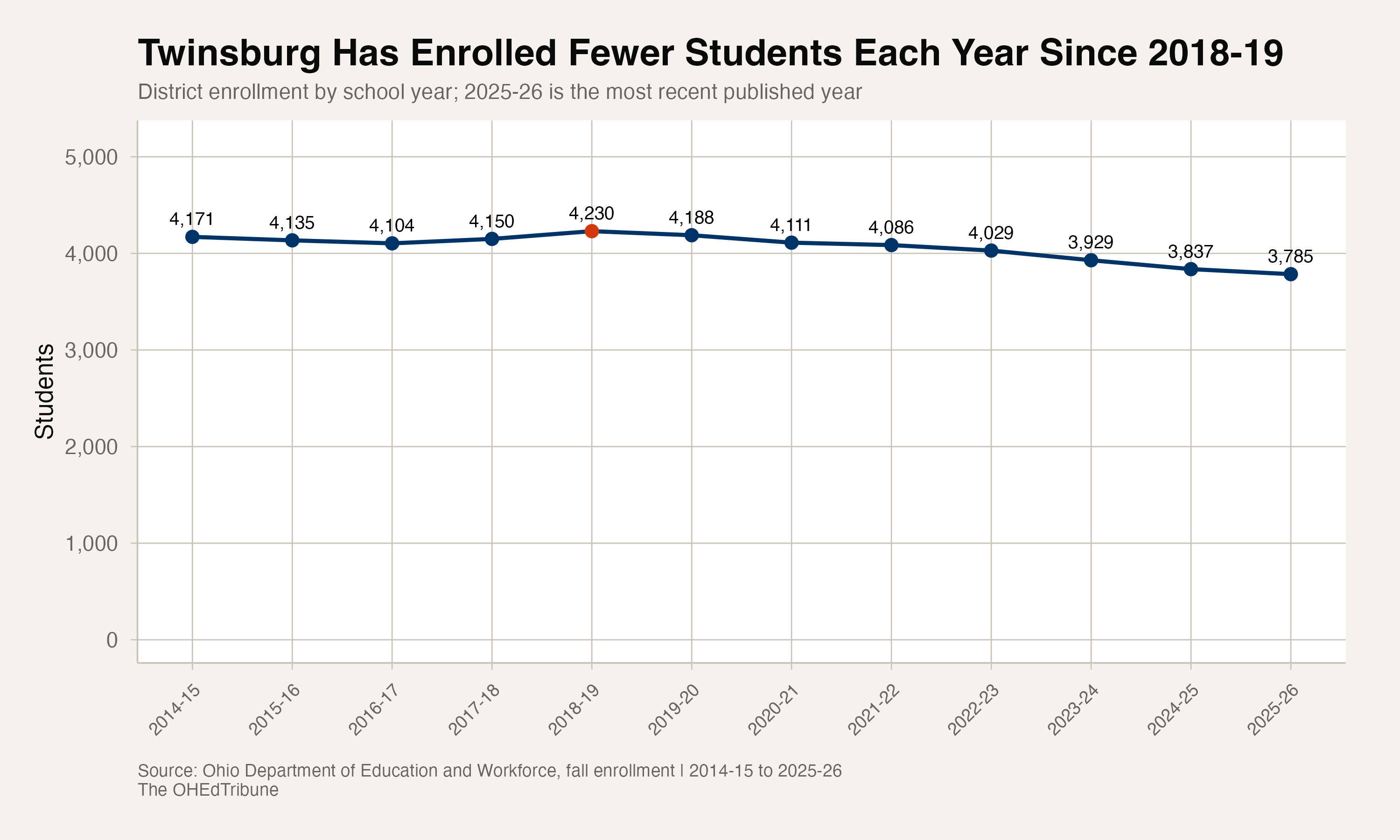
The 2025-26 count is 445 students below the 4,230 the district enrolled in 2018-19, and it came after seven straight annual declines across eight reporting years. The largest single drop was 100 students, in 2023-24. The most recent was smaller, 52 students. Measured from 2014-15, when the district counted 4,171 students, enrollment is down 386, or 9.3%.
The state's files record how many students enroll, not where the missing ones went. Smaller entering classes, families moving, and open enrollment could each produce this line, and the files cannot separate them.
The decline has not been spread evenly. Womack listed diversity among the reasons he came, and the counts show a district whose mix of students has shifted even as it shrank.
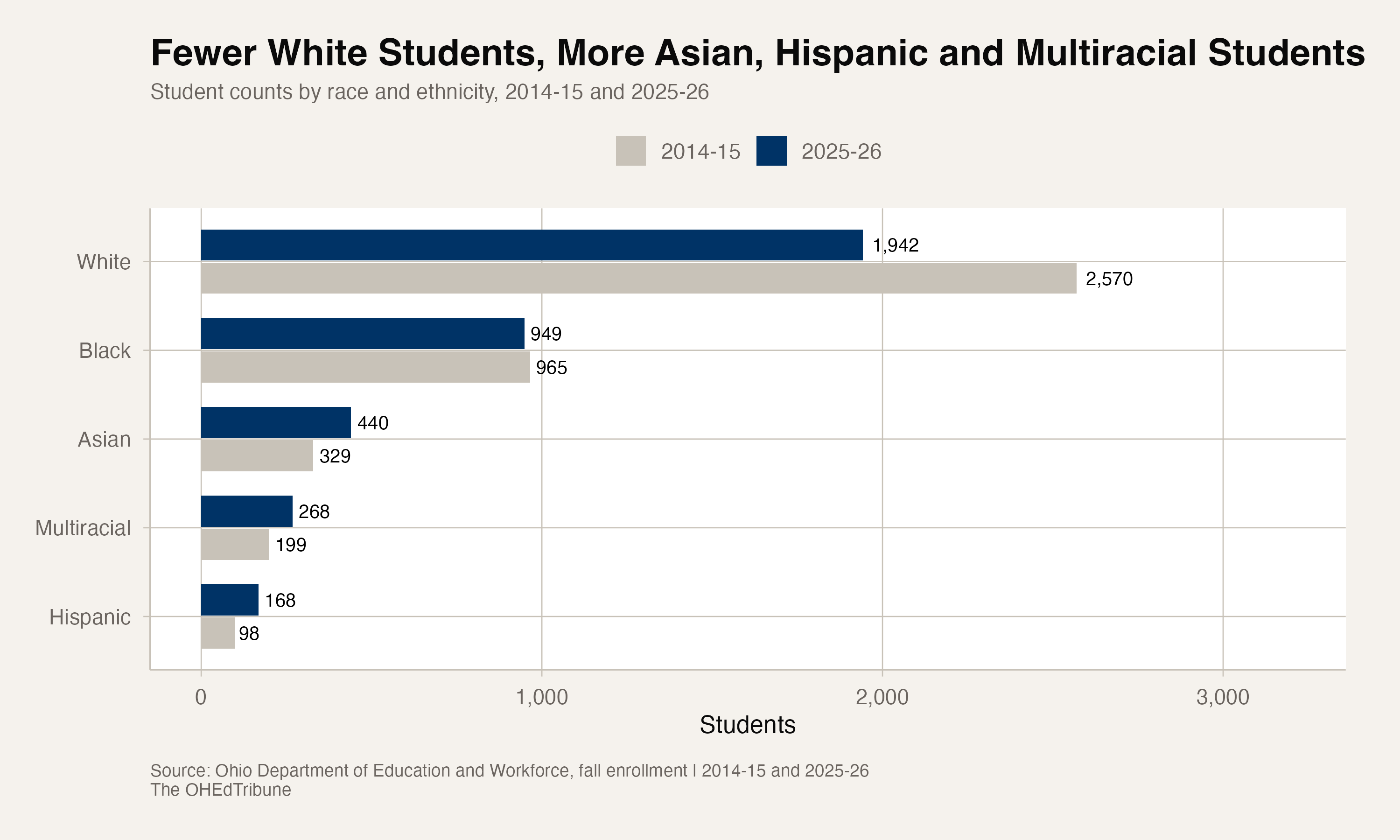
From 2014-15 to 2025-26, the number of white students fell from 2,570 to 1,942, a drop of 628. Over the same years, Asian enrollment rose from 329 to 440, multiracial enrollment from 199 to 268, and Hispanic enrollment from 98 to 168. The count of Black students held close to steady, 965 then 949.
The white decline is larger than the district's overall decline because those three other groups grew. That is arithmetic about who is enrolled in each year, not evidence that particular students left or arrived, and the state's files do not say why the mix changed.
A starting point for college credit
One of the ideas Womack named, more College Credit Plus offerings, has a measure in the state's report card. The report card files have no College Credit Plus line of their own. The closest measure they carry is the share of each graduating cohort the card tracks that earned 12 or more dual enrollment credits.
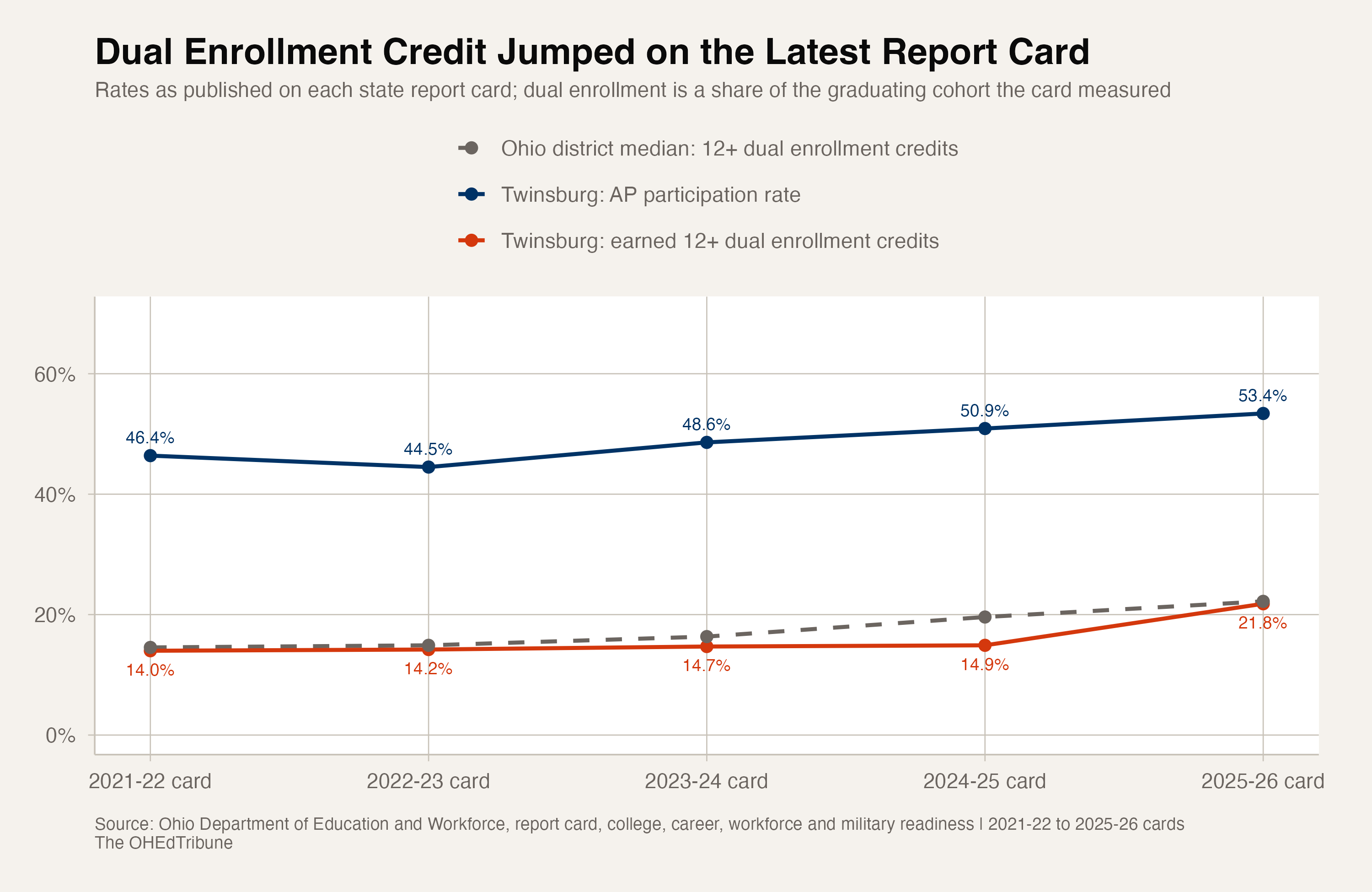
On the state's 2025-26 report card, 21.8% of the Twinsburg cohort it measured had earned 12 or more dual enrollment credits, up 6.9 points from 14.9% on the year before. For the four report cards before that, the rate sat between 14.0% and 14.9%. The latest figure is just under the median for the 606 Ohio districts with a reported rate on that card, 22.2%.
The jump is worth reading with care. The cohort the 2025-26 card measured was smaller, 298 students compared with 322 the year before, and a rate on a smaller group can move for reasons other than more students earning credit. The card also predates Womack's arrival, so it describes the program he inherited.
The report card's Advanced Placement participation rate has climbed more steadily. It rose from a low of 44.5% on the 2022-23 card to 53.4% on the 2025-26 card, above the 46.4% where the series began.
A legacy district
Asked which part of Twinsburg's existing culture he most wants to keep, Womack pointed back to what drew him there. "Today is only my 94th day in the district, and the part of the culture that I want to preserve is the legacy of academic excellence and preparing well-read, well-informed, and well-prepared students for the next stage in their lives," he wrote.
He described a community that stays. "This is a legacy district with multi-generational families attending, working, and staying in the area after graduation. Supporting this legacy and tradition is part of this culture."
He also set that legacy against a wider shift. "The United States Educational System is changing with funding, technology, AI, school safety, and academic preparation, and an increasing number of students and families addressing unique needs," Womack wrote. "How we respond and become proactive to the community and students needs will be paramount."
He wrote that his approach to the work rests on something simpler than a plan. "I have always felt that humility comes before honor and serving students has provided me a sense of purpose that keeps me motivated to lead."
None of the enrollment years above was counted while Womack led Twinsburg. The first one that is will be the 2026-27 count, and the listening he has started is meant to shape what comes after it.
Enrollment figures come from the Ohio Department of Education and Workforce's enrollment data, and dual enrollment and Advanced Placement rates from the department's school report cards. The most recent enrollment figures used here are for last school year, 2025-26.
Detailed code that reproduces the analysis and figures in this article is available exclusively to EdTribune subscribers.
Discussion
Sign in to join the discussion.
Loading comments...