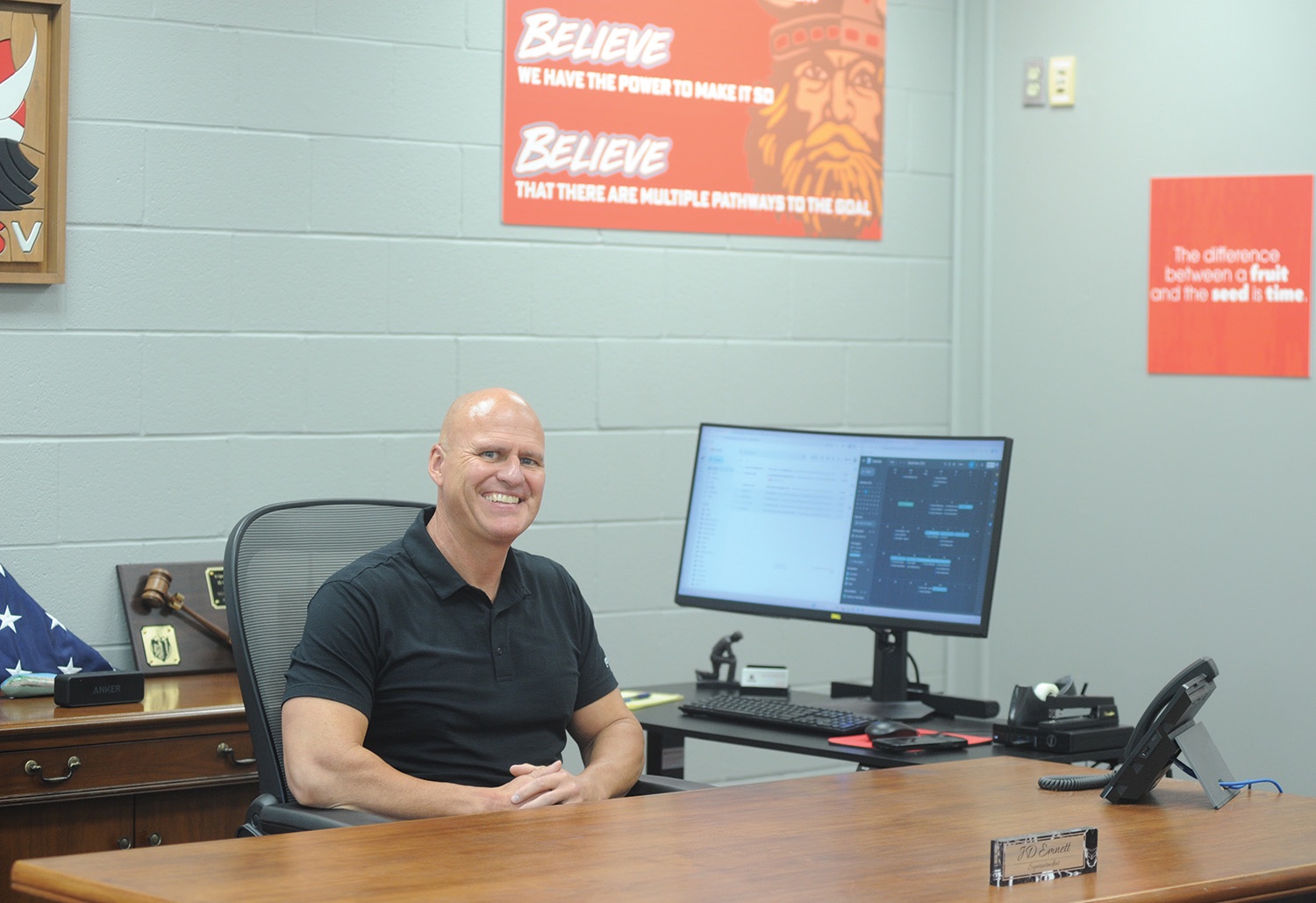
JD Emnett in his office at the Symmes Valley Board of Education. Photo: Heath Harrison, The Ironton Tribune.
JD Emnett knew Symmes Valley Local↗ET before he ran it. His work for the South Central Ohio Educational Service Center had brought him into the Lawrence County district over the past few years, The Ironton Tribune reported in September, and in August he became its superintendent, succeeding Greg Bowman.
He was hired in the spring and worked as a consultant for the district during the handoff from Bowman, the Tribune reported. Emnett, who lives in Wheelersburg, began as a teacher in Scioto County schools, then served as assistant principal at South Point High School and as principal of Green High School before joining the service center as a curriculum specialist. There he worked in curriculum support and directly supported students learning English as a second language, he confirmed to The OHEdTribune.
A brilliant child in every child
Emnett's guiding idea starts with students. "We believe there is a brilliant child within every child," he said.
He also leans on a slogan. A sign in his office reads "Who has it better than us? Nobody," and he has adapted it to "Who has it better than Symmes Valley? Nobody," the Tribune reported. As Emnett explains it, the line asks people to protect what the district has, to use it to keep moving forward, to share it with others, and to be grateful.
He described the community as a "no red lights" kind of place, small enough that it has no need for a stoplight, where families farm the land around town or commute to work.
Where attendance stands
For Emnett, the work on achievement starts with students being in school. "Attendance is the foundation" for raising academic achievement and growth, he said.
The state's attendance files show why that is a fitting place to start. In 2025-26, the most recent school year the state has published, 24.7% of Symmes Valley students were chronically absent, meaning they missed at least a tenth of the school year. That was up 4.4 points from 20.3% the year before, and it put the district above the statewide rate of 23.9% for the first time in the five school years the state's attendance files cover.
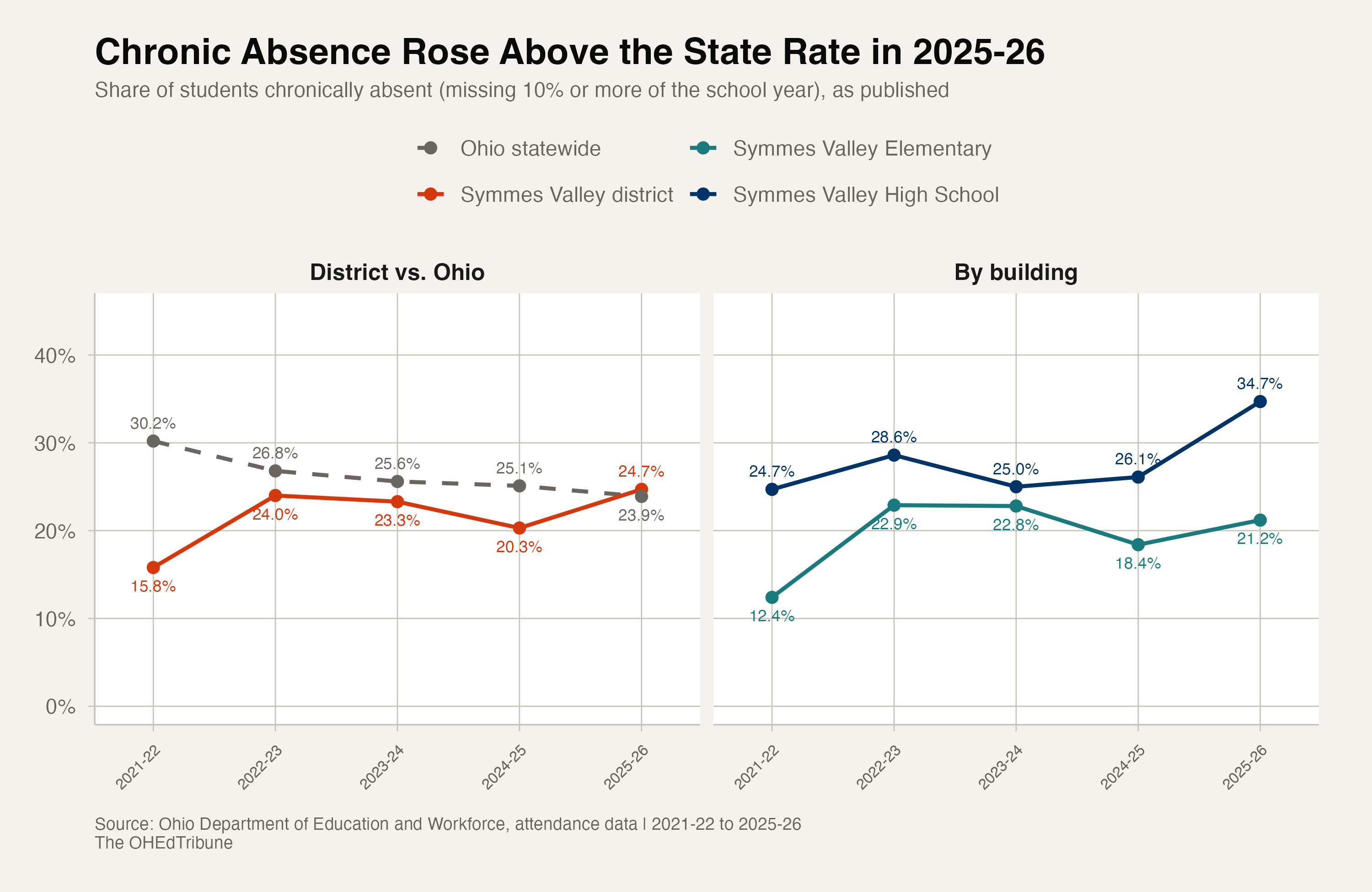
For most of that stretch, Symmes Valley had been below the state. In 2021-22, 15.8% of its students were chronically absent, when the statewide rate was 30.2%. The state's rate then fell every year, while the district's rose and dipped before climbing last year.
The increase was sharpest at Symmes Valley High School, where 34.7% of students were chronically absent in 2025-26, up from 26.1% a year earlier and the building's highest rate in the five years of data. At the elementary school, which serves kindergarten through eighth grade, the rate rose from 18.4% to 21.2%.
These are small schools, and in a district this size a few dozen students can move a rate by several points. The state's files record how much school students missed, not why they missed it. Every year in them also came before Emnett arrived. His first year, 2026-27, has not been published.
A smaller district last year
The state's enrollment files counted 682 students in Symmes Valley in 2025-26, the most recent school year in the state's published data. That is last year's count, not a figure for the 2026-27 school year Emnett now leads, and current-year counts will differ once the state publishes them.
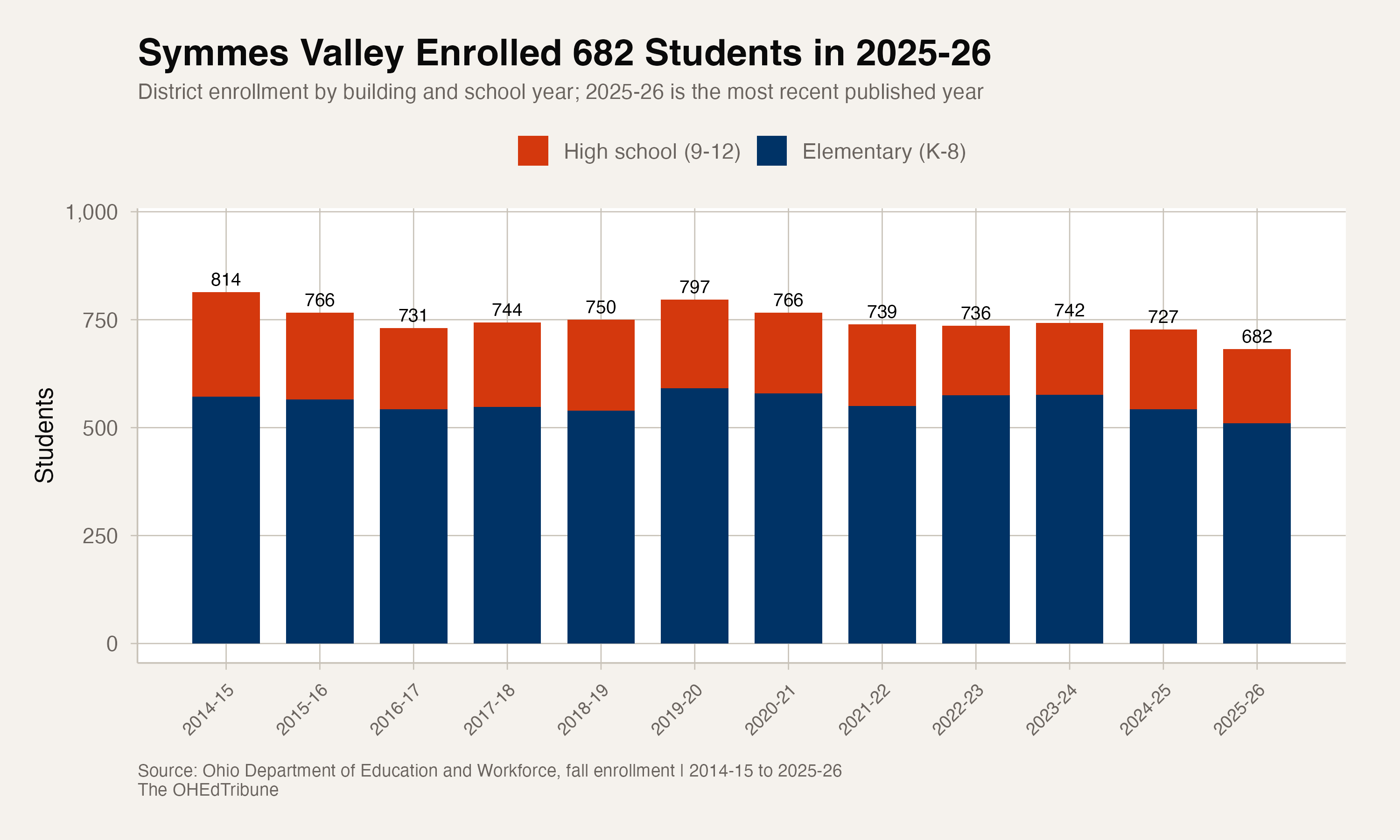
The 2025-26 count was 45 students below the 727 the district enrolled the year before. It was the largest one-year drop since 2015-16, when enrollment fell by 48, and the lowest count in the state's files, which reach back to 2009-10 with one year missing. The elementary school went from 543 students to 510, and the high school from 184 to 172. In 2019-20 the district counted 797 students, 115 more than last year.
Emnett said Symmes Valley works hard to attract students through open enrollment, and that it is working, with more students choosing to come into the district than to leave it. The state's enrollment files do not record where students come from or where they go, so they cannot test that. A district can gain students through open enrollment and still shrink overall if fewer children are living within its boundaries, and the files cannot separate those effects.
Most of the money comes from the state
"We try to be as efficient as we can with the funds we receive," Emnett said.
Most of those funds come from Columbus. In the 2024-25 fiscal year, state aid made up 60.2% of Symmes Valley's operating revenue, according to the expenditure and revenue rankings published with the state's report cards. The median among Ohio's 607 public school districts was 42.9%. Local sources supplied 24.5% of Symmes Valley's revenue, against a district median of 41.9%.
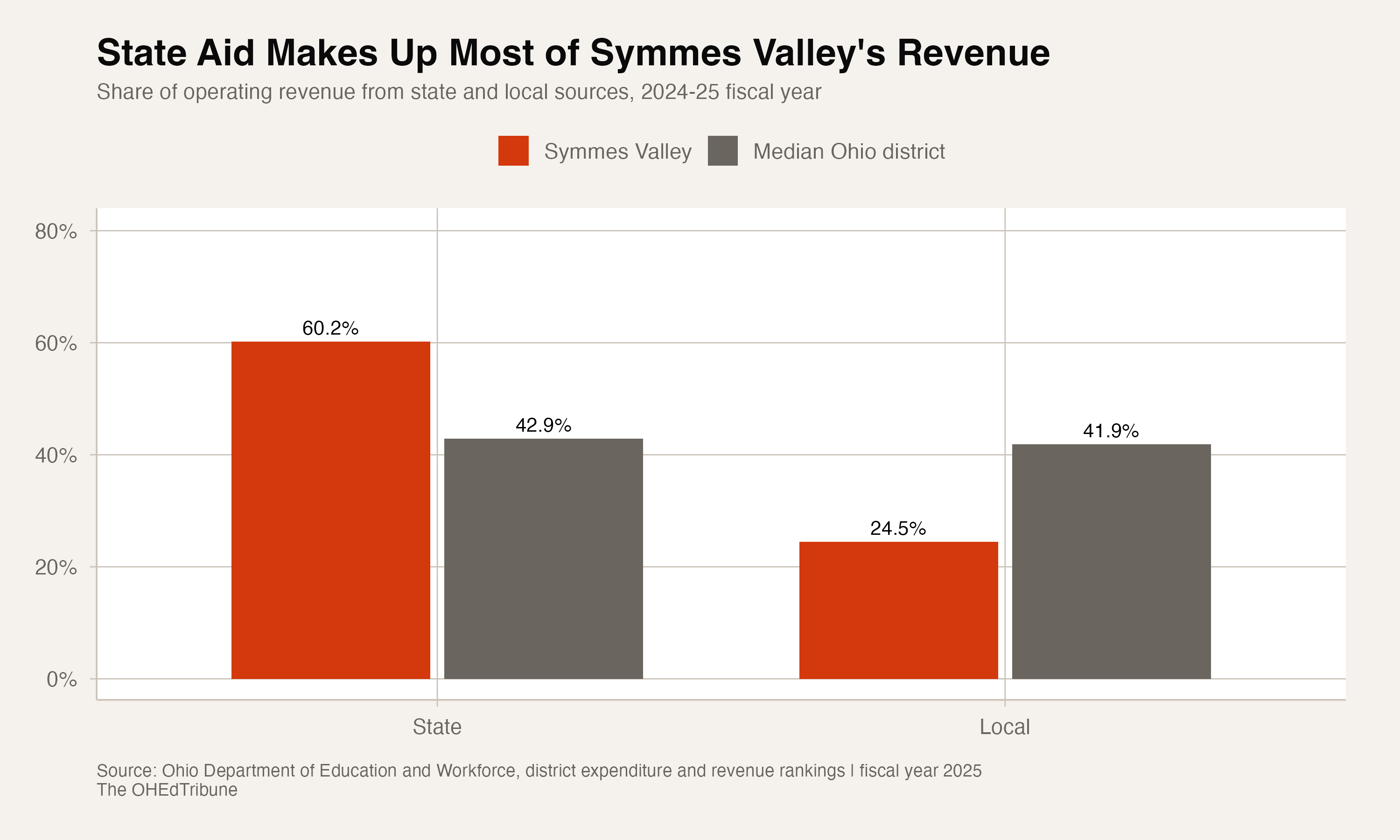
The district spent $13,213 per equivalent pupil on operations that year, slightly above the statewide district median of $12,854. A revenue mix that leans this heavily on the state means changes in state funding weigh more on Symmes Valley's budget than on a typical Ohio district's.
Telling the story
Emnett said he agreed to this profile because telling the district's story "shines a light on everything" Symmes Valley is doing.
He made the same case in September, when he told the Tribune that public education's reputation was something "we need to focus on and start telling our story," the paper reported.
The first attendance file that covers his tenure will be the one for 2026-27. It will show where the foundation he named stands after his first year.
Emnett reviewed the quotations from him in this profile and confirmed them in writing.
Enrollment figures come from the Ohio Department of Education and Workforce's enrollment data. Chronic absence rates and the revenue and spending figures come from the expenditure and revenue rankings and attendance files published with the department's school report cards. The most recent enrollment and attendance figures used here are for last school year, 2025-26.
Detailed code that reproduces the analysis and figures in this article is available exclusively to EdTribune subscribers.
Discussion
Sign in to join the discussion.
Loading comments...