
Steve Mohr was not looking for the job he now holds.
"This is not a position that I sought; in fact when the position opened and I was asked by a Board of Education member if I was interested in returning I said I was not and highly recommended someone else for the job," he wrote in response to questions from The OHEdTribune. He wrote that he spent a considerable amount of time preparing that person for the interview, and that the person chose not to take the position.
Mohr took it instead. He is superintendent of Wynford Local↗ET, the Crawford County district that first hired him as superintendent in 2006 and that he retired from in 2015. "I officially started as superintendent on August 1st but worked as a consultant for the district from July 13-August 1st," he wrote. Eleven years after the retirement, the seat is his again.
"After discussions with several individuals whose opinion I valued and much prayer I decided to offer my services to the Board and they offered me a 2 year contract," he wrote.
Some of the pull is family. "Wynford is a special place for my family," Mohr wrote, before listing the reasons: his wife is a Wynford graduate, both of his children are Wynford graduates, and he spent part of his career in education at Wynford. He frames the work itself as an obligation rather than a choice. "I have always seen education as a calling and believe that if you have something to offer you should make yourself available," he wrote.
There was also a debt. "Wynford was very supportive of me when, during the last 2 years of my time here, I was diagnosed with an incurable cancer and went through a pretty intense treatment regimen," Mohr wrote. "I saw coming back to Wynford as an opportunity to pay back the district for their support."
The district's published grade counts
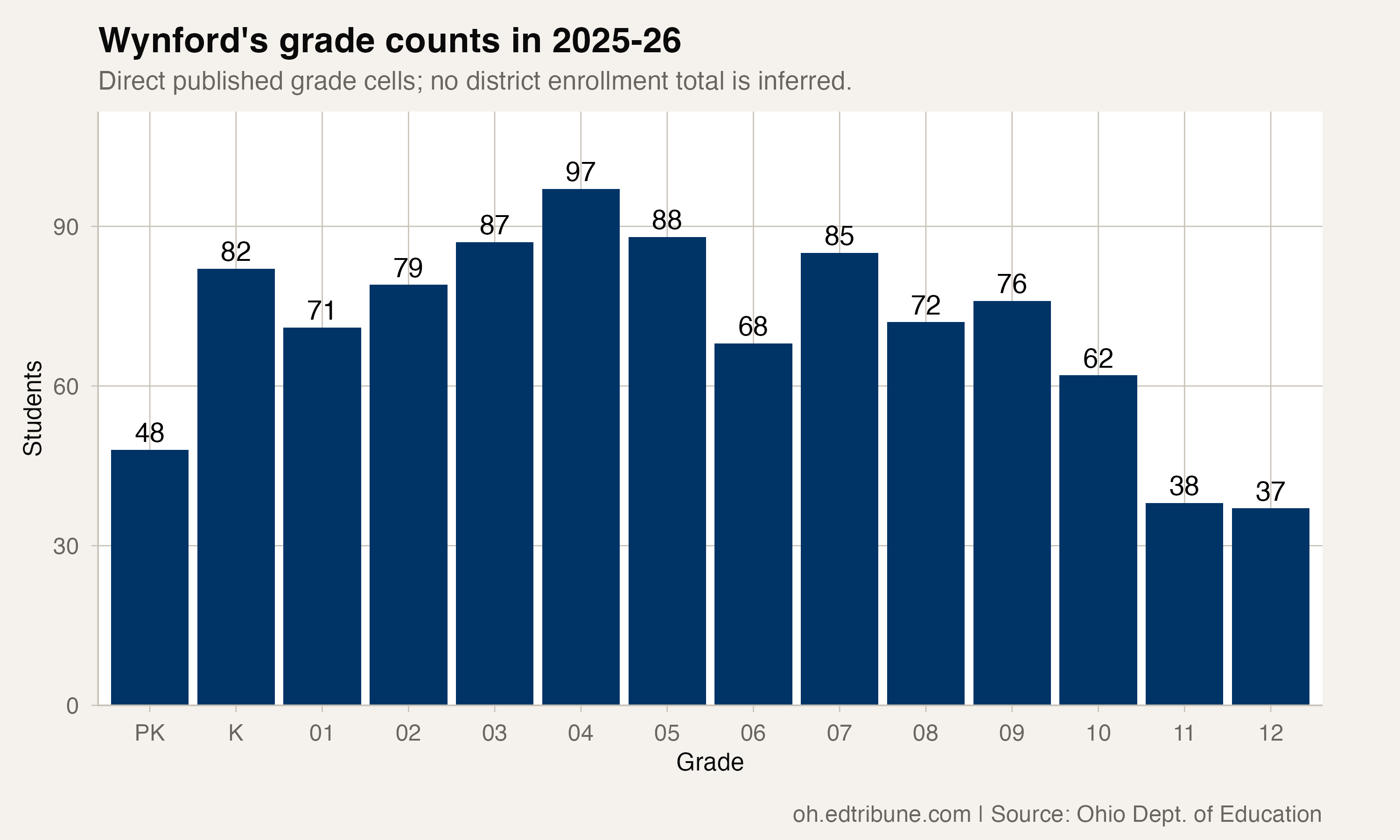
Ohio's most recent published enrollment file covers last school year, 2025-26. It lists 76 ninth graders, 62 tenth graders, 38 eleventh graders and 37 twelfth graders at Wynford Local. These are individual grade counts. A compatible published district total is unavailable in this comparison, so the grade rows are not added into a district headcount or used to calculate demographic shares.
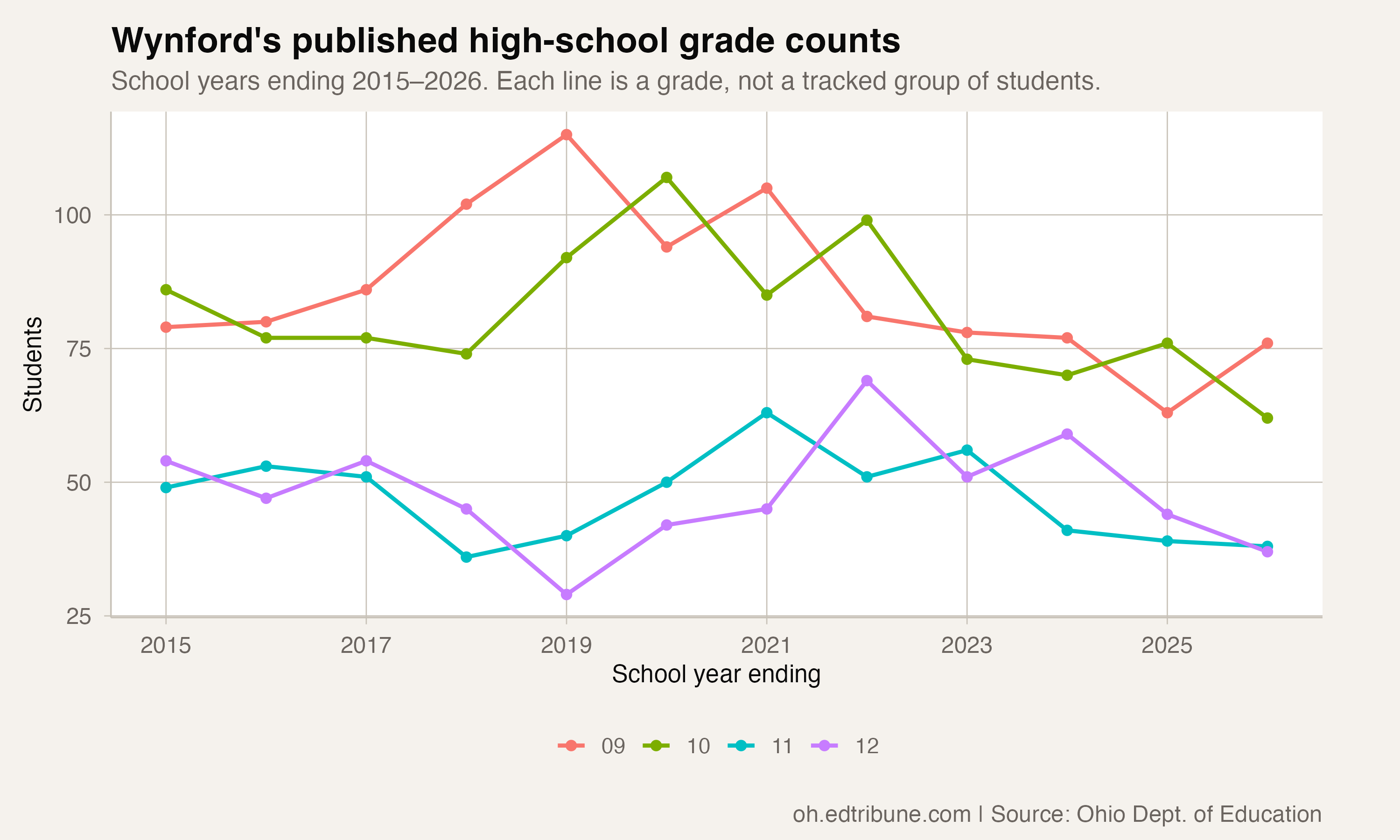
The older figures provide a useful view of the grades Mohr was asked about. In 2024-25, the state counted 63 ninth graders, 76 tenth graders, 39 eleventh graders and 44 twelfth graders. Each observation describes the students reported in that grade and school year. The history does not follow named students from one year to the next.
What he noticed in the first few weeks
"Perhaps the biggest change I have noticed has to do with the demographics," Mohr wrote.
He described the free and reduced lunch numbers at Wynford as now above half. That is his account of the district. A comparable published district enrollment total is unavailable for calculating that share independently here.
The second shift Mohr described is one the enrollment counts cannot measure. "While the number as a percentage of the overall population hasn't changed much, the severity of the disabilities has risen sharply and this has impacted the district significantly from a financial standpoint," he wrote.
The cost pressure he describes is his own assessment of what those services now require. The state's grade counts cannot measure the severity of a disability or establish the fiscal effect of a particular student's services. Those questions require the district's own program and budget records.
One more change he named has nothing to do with students at all. "The amount of time one has to spend on monitoring and filing reports with the state is overwhelming," he wrote of how the superintendency itself has changed.
Where the high school gets small
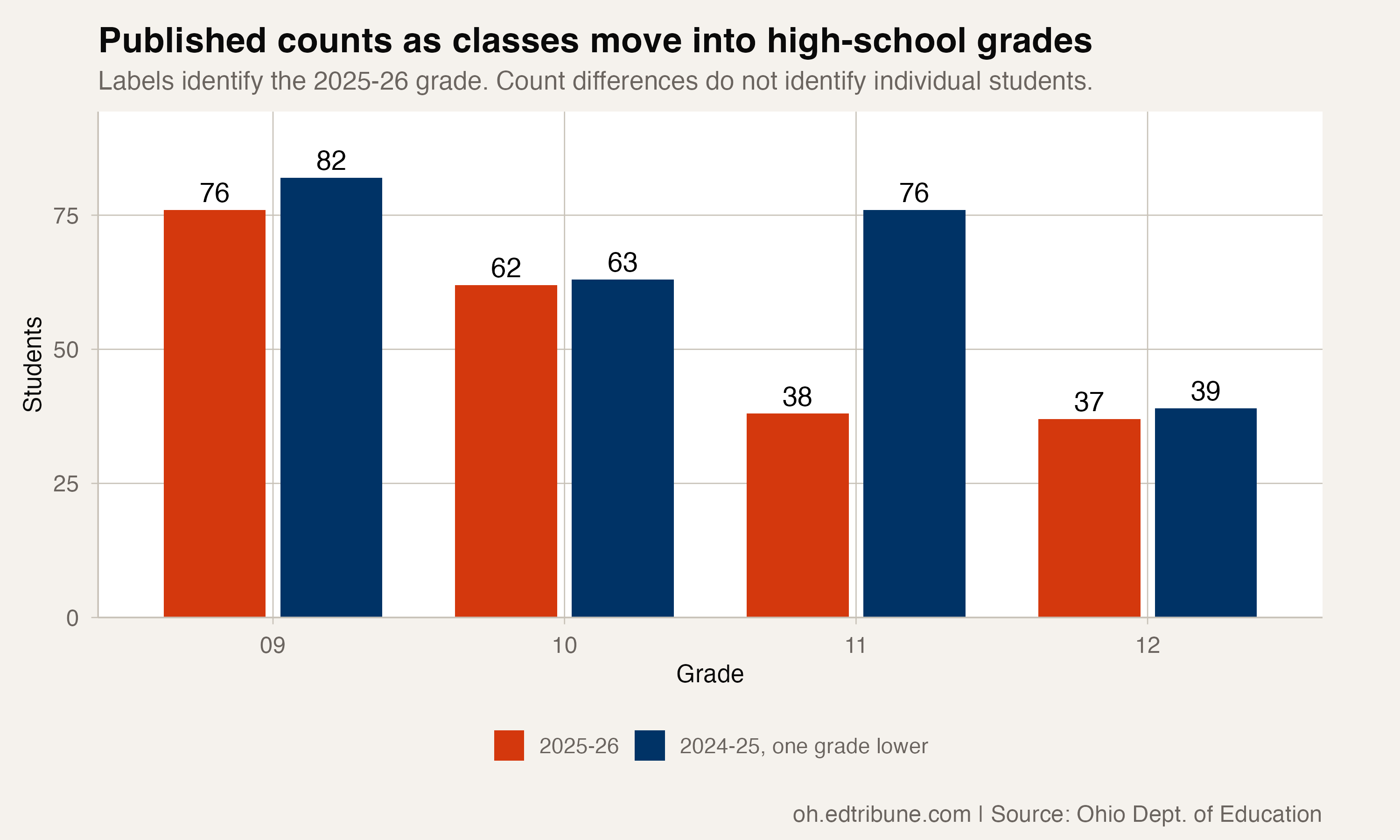
The difference between the lower and upper high-school grades remains visible in the state's newest file. The 76 tenth graders reported in 2024-25 were followed by an eleventh-grade count of 38 in 2025-26, a difference of 38 students. That arithmetic describes the change in reported class size. It cannot establish how many particular students left or where they went.
Asked how much of the gap is students counted at the joint vocational school, Mohr ruled that out. "Those students attending joint vocational schools are included in the class counts," he wrote. "What has impacted the class sizes is the number of students who are being home schooled, have open enrolled out, and have chosen parochial schools." He does not read the gap as a limit on what the high school can offer: "This reduction in number is not significant enough to affect what we offer students academically."
Those are Mohr's explanations. The published grade cells carry no field connecting a student to a destination, so none of the routes he named can be sized from these records. The file also cannot separate movement between schools from grade repetition or other changes in who is reported. What it supplies is a count for each grade, with the smaller upper-grade classes visible at both endpoints.
Two years
The board offered two years, and Mohr took them for reasons that have little to do with these counts: a district that supported him through an illness, a wife and two children who graduated from it, and a view of education as a calling. His answer about academic offerings gives the grade figures a practical boundary: he says the class-size gap does not limit what students can study. Understanding any future change in those offerings will require a district decision or program record alongside the headcounts.
Enrollment grade counts come from the Ohio Department of Education and Workforce, covering the 2014-15 through 2025-26 school years. Mohr answered in writing and supplied the professional headshot.
Detailed code that reproduces the analysis and figures in this article is available exclusively to EdTribune subscribers.
Discussion
Sign in to join the discussion.
Loading comments...