Correction: This article originally understated the traditional district enrollment decline. The correct figures are included below.
Ohio Virtual Academy enrolled 14,264 students in 2018-19. Two years later, with schools across the state shuttered or running hybrid schedules, it had surged to 20,900. By 2025-26, that number has settled at 15,920. The pandemic boom faded, but 1,656 of those students, 11.6% above the pre-COVID baseline, never went back.
That pattern, in miniature, captures what happened across Ohio's entire community school sector. Since 2018-19, community schools added 17,459 students, a 16.2% gain. Traditional districts lost 139,647, an 8.9% decline. Two sectors in the same state, drawing from the same pool of families, moving in opposite directions.
A recovery gap measured in hundreds of districts
Among the 580 traditional districts and 262 community schools with enrollment data in both 2018-19 and 2025-26, the recovery patterns look like different states.
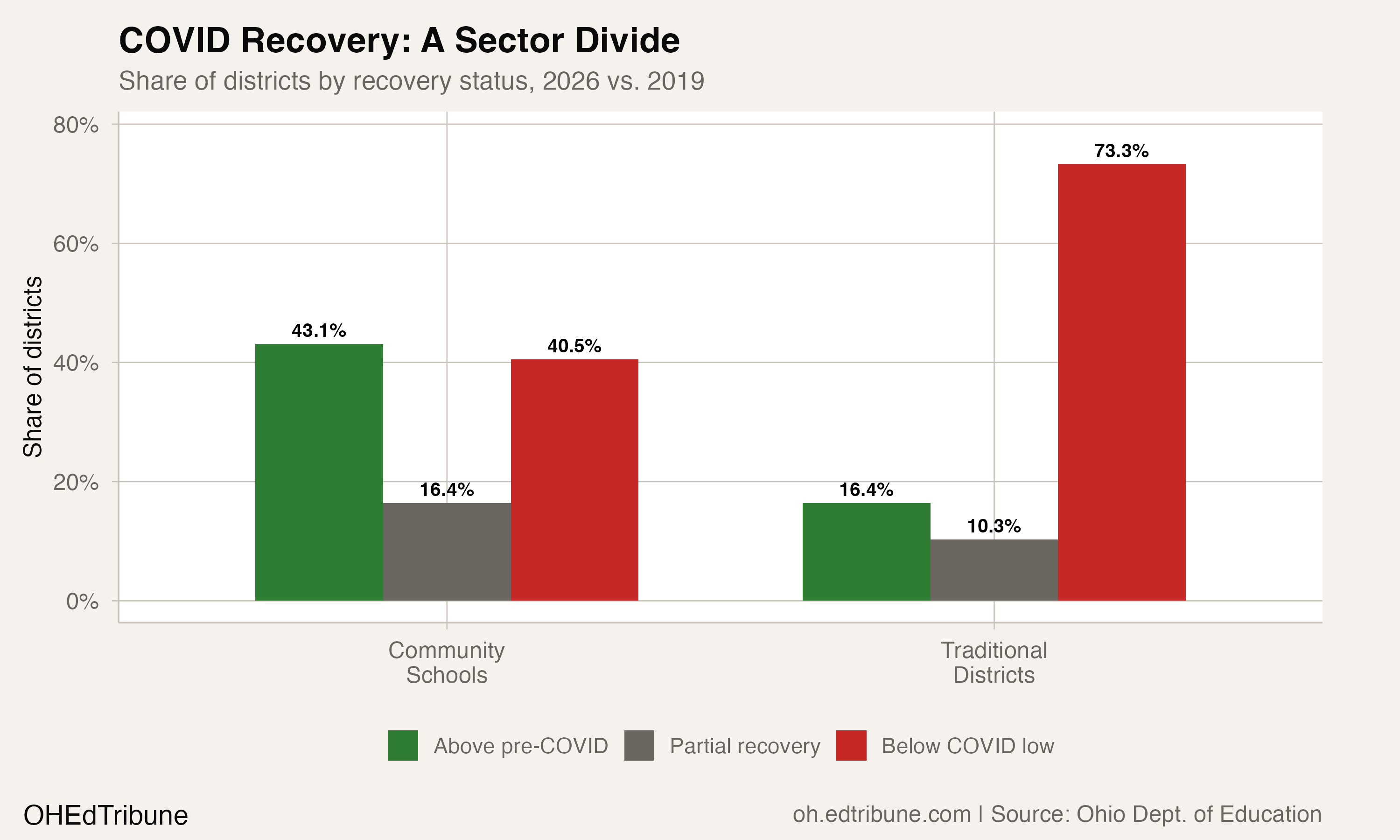
Of community schools, 42.7% now enroll more students than they did before the pandemic. Only 16.2% of traditional districts have reached that threshold. At the other end, 74.8% of traditional districts sit below their COVID-era low point, still losing ground after six years. For community schools, that figure is 43.1%.
The student-weighted picture is even starker. Among community school students, 67.9% attend a school that has grown past its pre-COVID enrollment. Among traditional district students, 68.3% attend a district that has fallen below its worst pandemic-year level.
A caveat on the district-count comparison: community schools average roughly 367 students, compared to about 2,478 for traditional districts. Smaller organizations are inherently more volatile. A single grade cohort can swing a community school's recovery classification. The student-weighted numbers, which show 67.9% of community school students in above-pre-COVID schools, are a more reliable measure of the sector's actual trajectory.
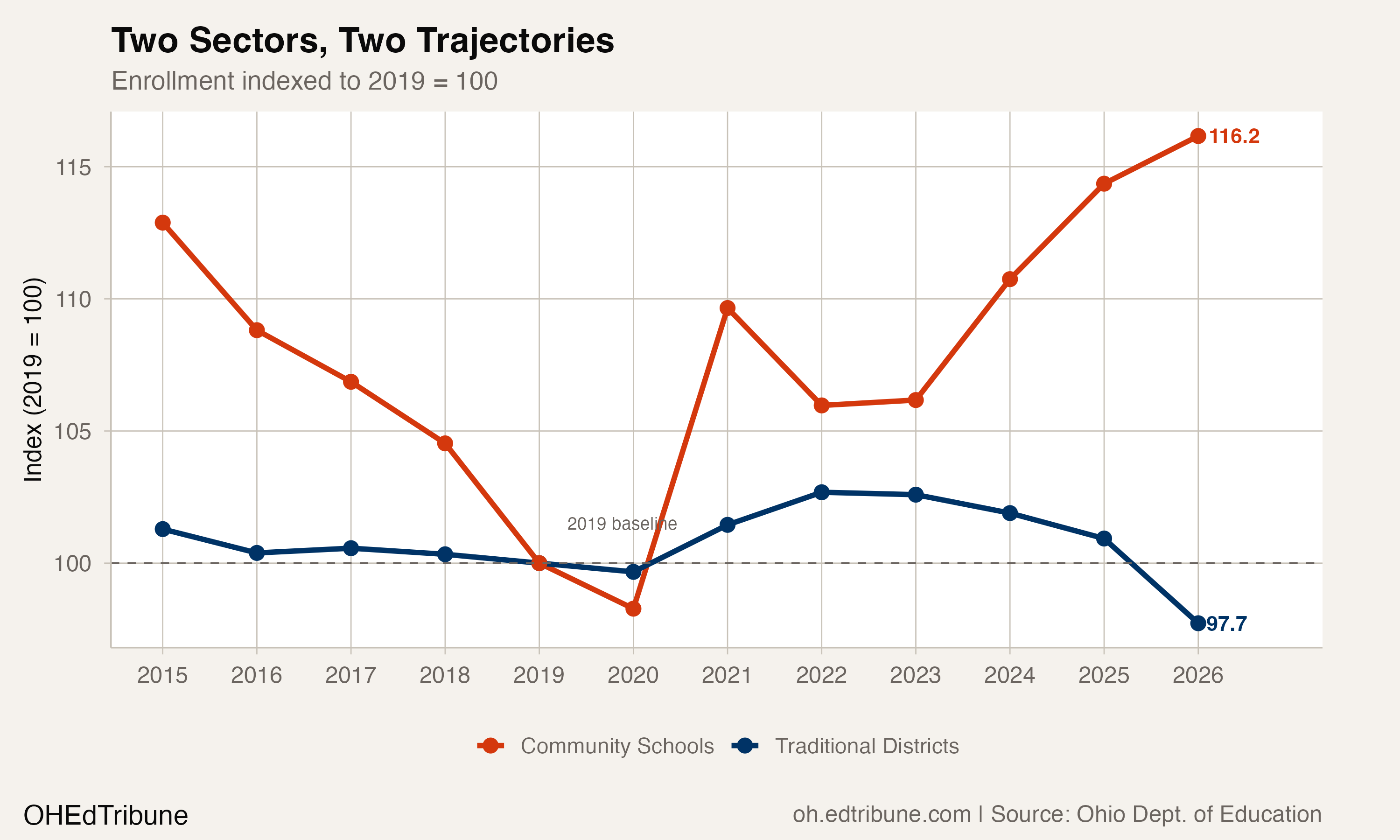
Indexed to 2019 levels, community schools sit at 116.2 in 2026. Traditional districts sit at 91.1. The gap has been widening every year since 2022.
Brick-and-mortar charters are driving the growth
The obvious explanation is that virtual schools absorbed pandemic demand and kept it. That is partly true: five virtual community schools, led by Ohio Virtual Academy (15,920 students), Ohio Connections Academy (5,199), and Alternative Education Academy (5,324), enrolled 29,547 students in 2026, up from 24,340 in 2019.
But the less obvious story is in the brick-and-mortar schools.
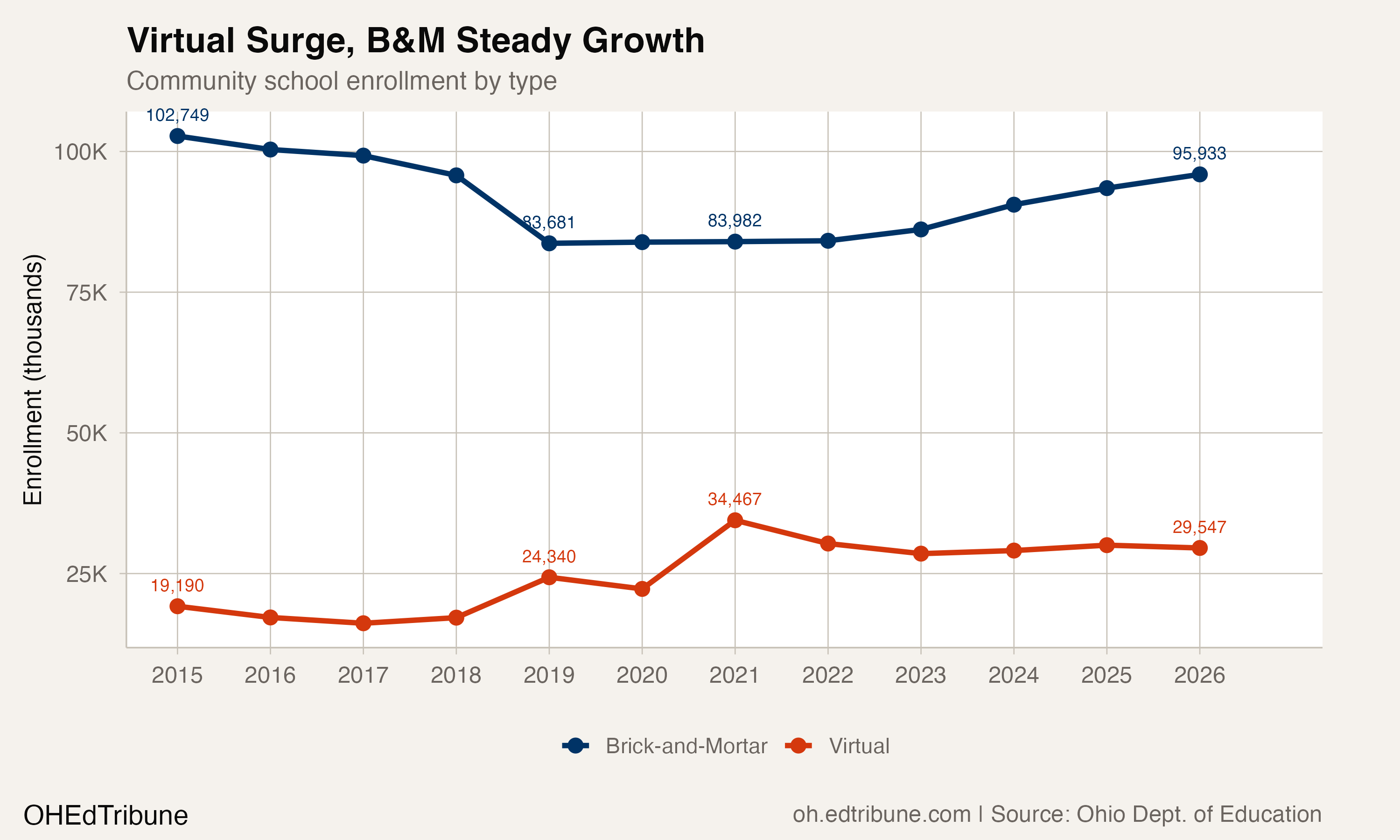
Brick-and-mortar community schools enrolled 83,681 students in 2019. They held nearly flat through the pandemic at 83,982 in 2021, then grew steadily to 95,933 in 2026, a gain of 12,252 students, or 14.6%. Virtual schools, by contrast, surged in 2021 and then partially retreated: 24,340 in 2019 to 34,467 in 2021 to 29,547 in 2026.
Among the 257 brick-and-mortar community schools with data in both 2019 and 2026, 42.4% have grown past pre-COVID levels, while 40.9% have fallen below their COVID low. This comparison only includes schools that survived the full period; community schools that closed between 2019 and 2026 are excluded, which likely biases the surviving set toward healthier operations. The pattern is not uniform. KIPP Columbus grew from 1,392 to 2,269 students, a 63.0% increase. Village Preparatory School went from 419 to 1,075. Citizens Academy Southeast went from 404 to 982. These are not schools riding a virtual enrollment wave. They are in-person operations that families chose.
Where the students came from
Ohio's five largest traditional districts tell part of the story. Cleveland Municipal↗ET lost 5,265 students since 2019, a 14.0% decline. Columbus City Schools District↗ET lost 3,204 (-6.5%). Toledo City↗ET lost 2,792 (-12.0%). Akron City↗ET lost 1,929 (-9.1%). Cincinnati Public Schools↗ET lost 1,562 (-4.5%). Together, these five districts account for 14,752 of the traditional sector's 139,647-student net loss, or 10.6%.
Community schools are not the only destination. Ohio's EdChoice Expansion voucher program now serves more than 100,000 students after the legislature opened eligibility to all income levels. Private schools added 18,327 students between 2020-21 and 2024-25, far more than the 4,941 net gain in community schools over that same period.
The community school sector's growth, in other words, is happening in a market where traditional districts face competition on multiple fronts simultaneously: from charters, from voucher-funded private schools, and from declining birth cohorts.
Market share at its highest point
Community schools now account for 8.0% of Ohio's combined traditional-and-community-school enrollment, the highest share in the dataset. That figure bottomed at 6.3% in 2020, when traditional districts still had their pre-pandemic base intact and community schools were in the middle of a five-year slide from their 2015 peak.
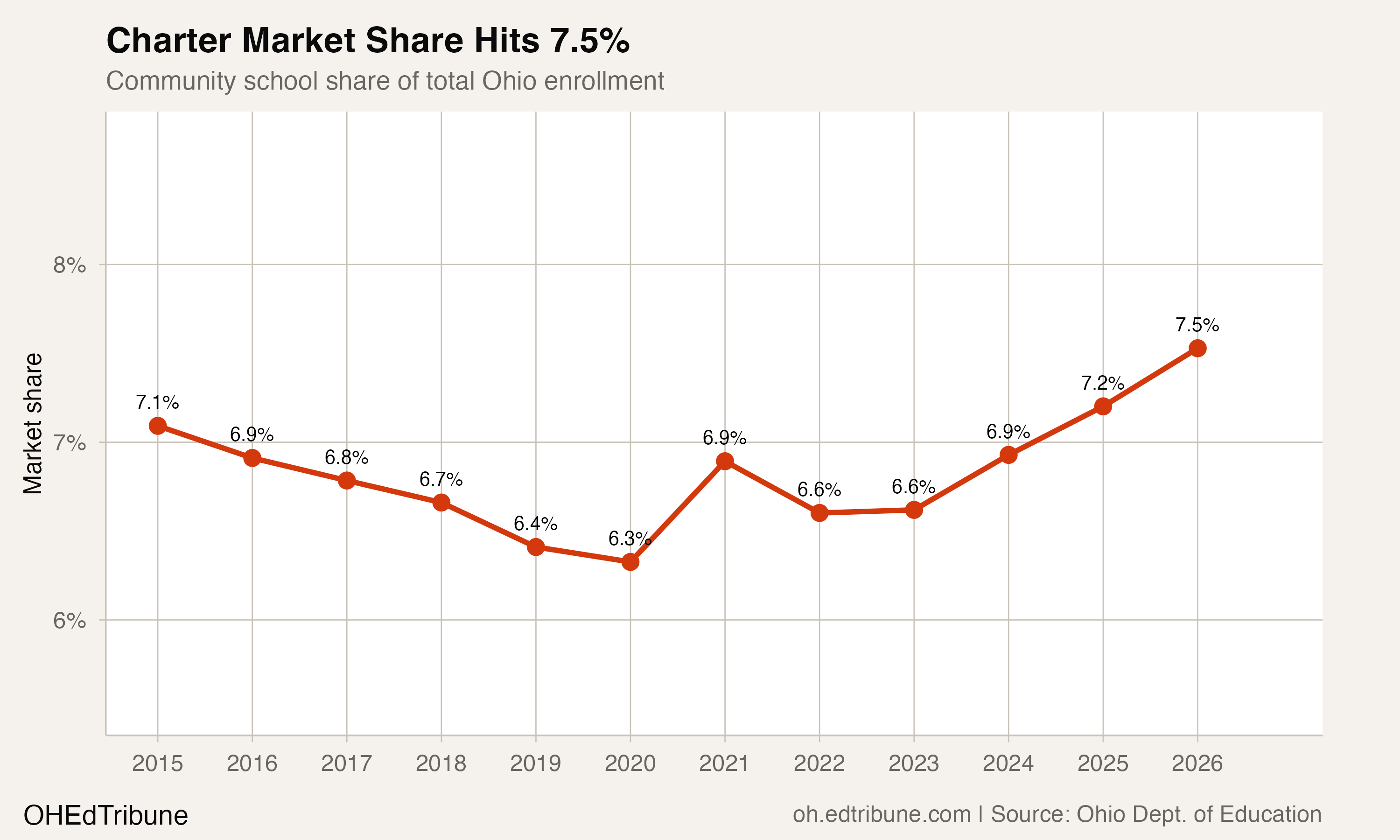
The share trajectory is a U-shaped curve. From 2015 to 2020, community schools steadily lost ground, dropping from 121,939 to 106,159 students as the state tightened accountability standards and closed low-performing schools. The number of community school entities fell from 375 to 311 over the same period.
That contraction reversed in 2021, and the sector has grown every year since, reaching 342 entities and 125,480 students in 2026. The post-2020 rebound has been powered by a mix of virtual enrollment retention, brick-and-mortar expansion, and new school openings.
What policy and reporting suggest
The Fordham Institute, which sponsors 10 Ohio community schools, has documented the post-pandemic enrollment competition between charters and traditional districts. Its analysis of 2023-24 data found that brick-and-mortar charter enrollments rose 4.9% in a single year, a gain of 5,829 students.
Ohio's Quality Community School Support Fund, created in 2019, provides high-performing community schools with additional per-pupil funding ranging from $980 to $1,600 depending on the year. Andrew Boy, who leads United Schools in Columbus, told the Fordham Institute that the funding has enabled better teacher compensation:
"Since the addition of the QCSSF, we've been able to vastly improve teacher pay to attract and retain more effective, experienced staff, which allowed us to serve more students and deliver on our mission."
Beth Lawson of School Choice Ohio described the broader dynamic in terms of family expectations: "During this period, families have faced unprecedented disruptions, and many parents have become more engaged in evaluating the learning environment, academic outcomes, and safety of their child's school."
The 2026 picture
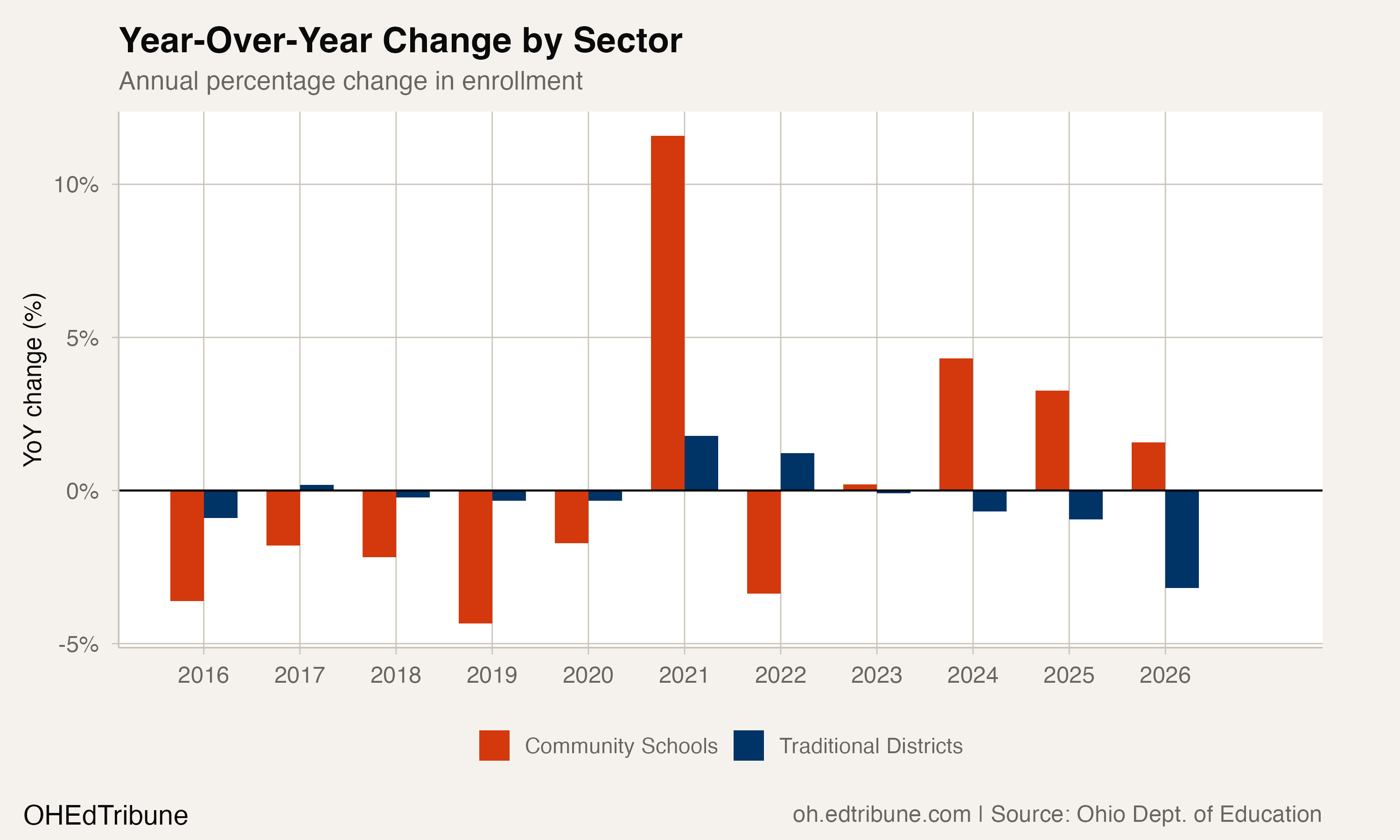
In 2026, the sectors moved in sharply different directions. Community schools gained 1,949 students (+1.6%). Traditional districts lost 54,758 (-3.7%), the largest single-year decline in the dataset. Of 326 community schools with year-over-year data, 177 (54.3%) grew. Of traditional districts, 445 declined and 128 grew.
That 2026 traditional-district drop is so large it merits a caveat: the Ohio Department of Education restructured some district IRN codes in 2026, affecting roughly 40 entities. Some of the apparent loss may reflect administrative reclassification rather than actual enrollment decline. But even adjusting for that, the traditional sector's trajectory has been negative for three consecutive years.
The brick-and-mortar growth — 12,252 students over seven years in schools where families physically show up each morning — is not easily dismissed as a pandemic artifact. KIPP Columbus added 877 students. Village Prep nearly tripled. These are in-person operations that grew through a period when the state's traditional system contracted by 139,647.
But Ohio's school choice market has never been this crowded. With 342 community schools, a $1 billion voucher program now open to all income levels, and 61,000 homeschoolers, every sector is carving from the same shrinking total. The community schools that survived the state's accountability purge from 2015 to 2020 proved they could attract families. Now they have to hold them in a market where the next option is always one enrollment form away.
Detailed code that reproduces the analysis and figures in this article is available exclusively to EdTribune subscribers.
Discussion
Sign in to join the discussion.
Loading comments...