Correction (April 12, 2026): This article originally described the 2025-26 total enrollment loss of 19,611 as "the largest single-year decline in the dataset." The 2020-21 pandemic year saw a larger decline of 52,242. The text has been corrected to read "the largest single-year decline outside the pandemic year."
The pandemic was supposed to be the floor. In 2020-21, when Ohio lost 10,457 kindergartners in a single year, the assumption was that families had delayed enrollment and would return. Many did. But the return was temporary, and the trajectory since has been steadily downward. Ohio's kindergarten class of 2025-26 stands at 112,390 students, the smallest in the 12 years of available data, and 1,865 below the COVID low of 114,255.
That number, 16,778 fewer kindergartners than in 2014-15, is not just a headline. It is a 13.0% decline that will ripple through Ohio's elementary schools for the next five years, shrinking classrooms, straining staffing ratios, and forcing budget recalculations in districts that are already losing students from every direction.
Smaller classes, every year since the bounce
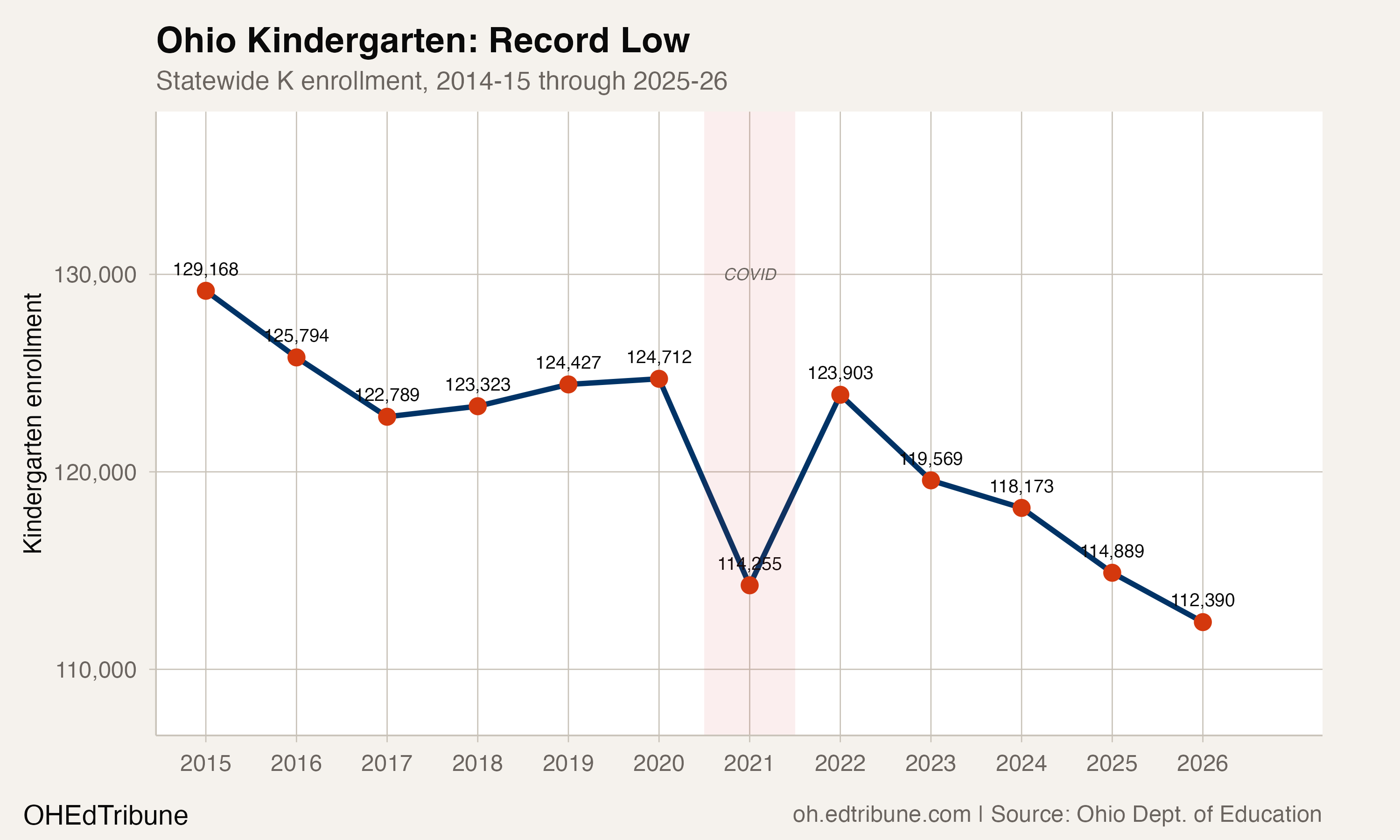
The shape of the kindergarten trend tells a story of false recovery. Ohio's K enrollment fell sharply in 2016 and 2017, stabilized near 124,000 for three years, then cratered during COVID. The 2021-22 bounce back to 123,903 looked like a return to normal. It was not. Since that bounce, K enrollment has fallen every year: by 4,334 in 2022-23, by 1,396 in 2023-24, by 3,284 in 2024-25, and by 2,499 in 2025-26. Four consecutive years of decline, each building on the last.
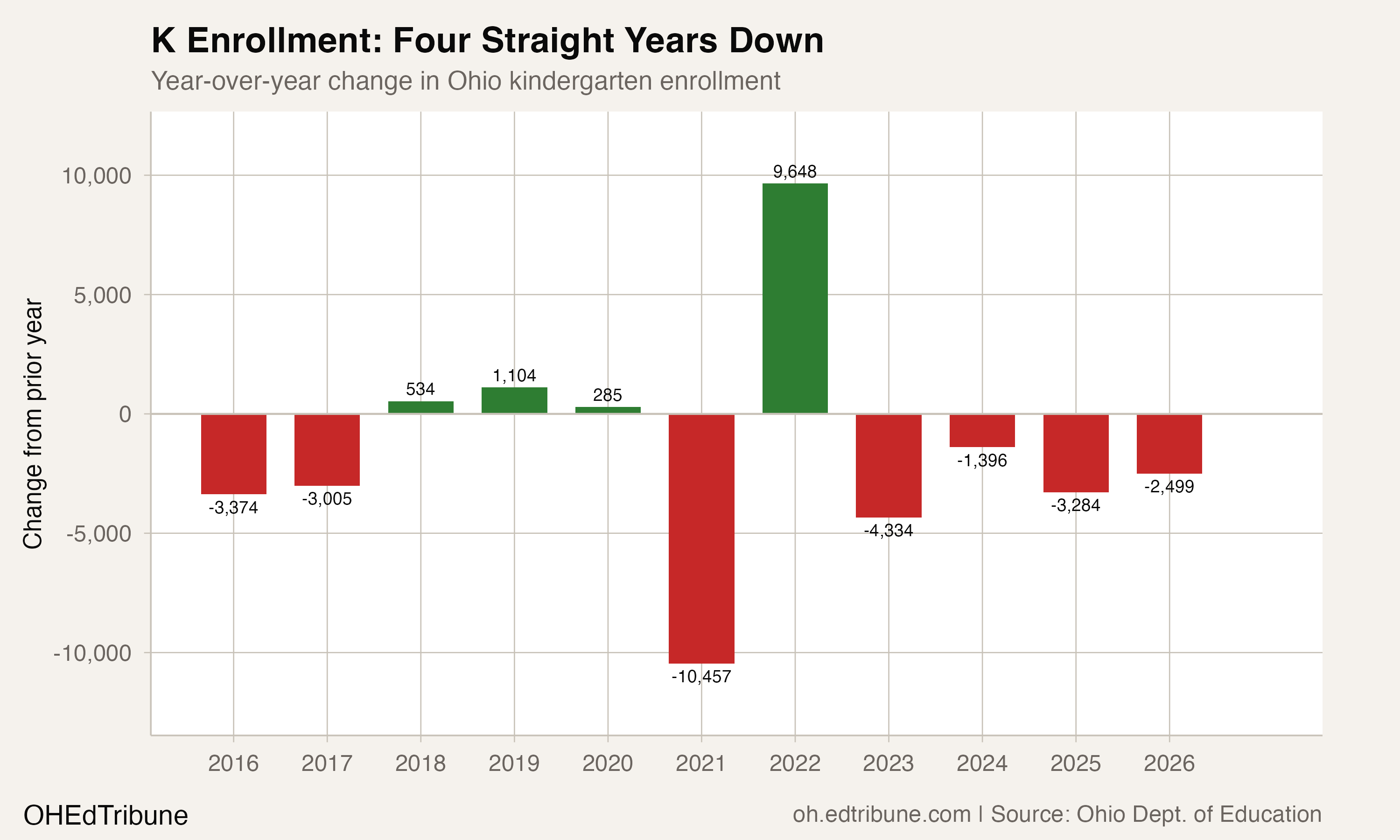
The cumulative loss since the post-COVID peak is 11,513 kindergartners. That bounce-back year increasingly looks like a one-time event, as families who had held children out of kindergarten during the pandemic sent them all at once, briefly inflating the count before the underlying demographic decline reasserted itself.
82 kindergartners for every 100 seniors
The gap between who enters Ohio's school system and who exits it has been widening for a decade. In 2014-15, Ohio enrolled 129,168 kindergartners and 135,707 seniors, a K-to-grade-12 ratio of 95.2. That ratio has since dropped to 81.5. Ohio now has 25,505 more 12th graders than kindergartners.
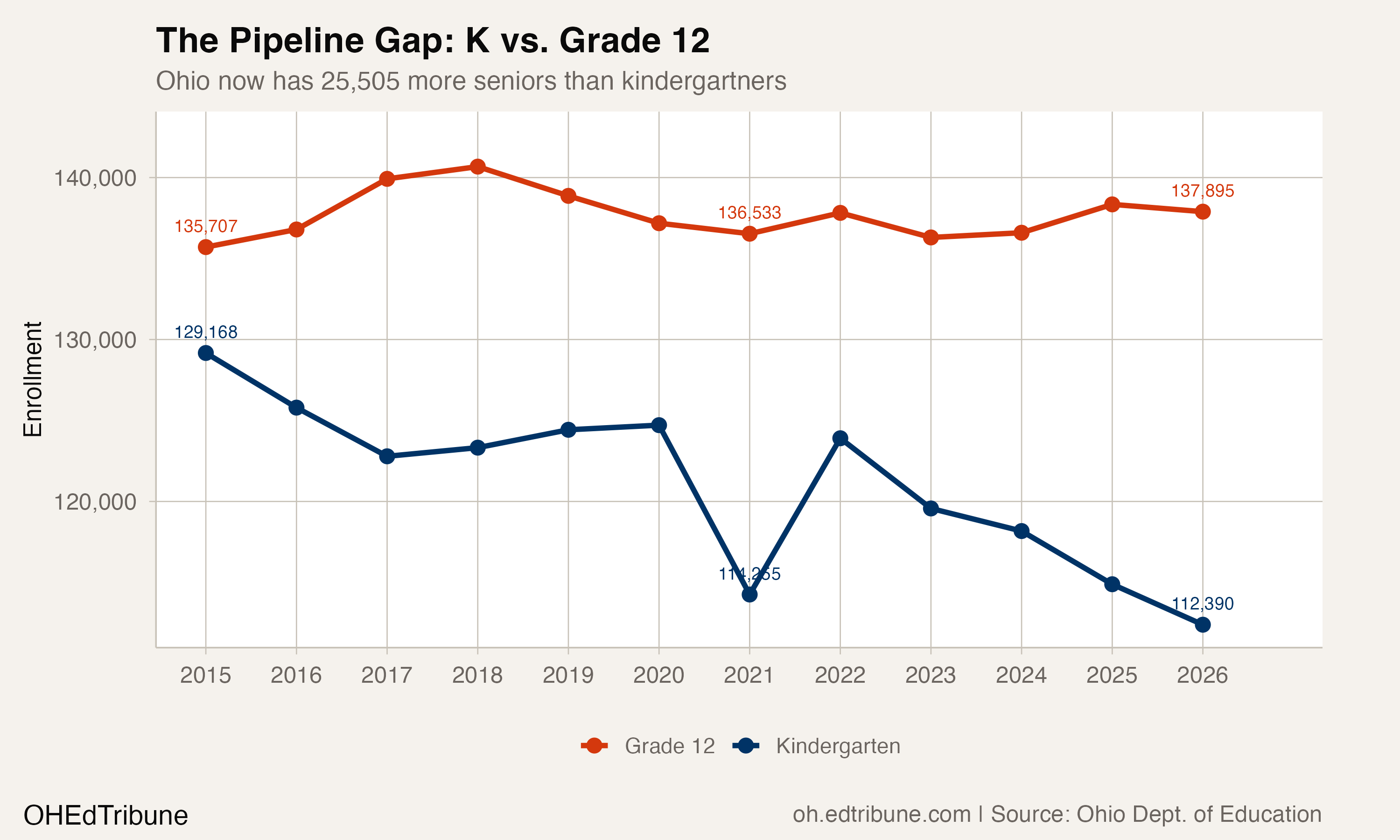
Grade 12 enrollment has been remarkably stable, hovering between 135,700 and 140,700 across all 12 years. Those seniors reflect birth cohorts from 2007-08, when Ohio was still producing roughly 150,000 births per year. Ohio's 2025-26 kindergartners were born in 2019-20, when the state recorded about 127,000 births, a gap of roughly 23,000 births per year that guarantees the pipeline will keep narrowing.
The operational implication is concrete. As those large senior classes graduate and are replaced by smaller entering cohorts, total enrollment declines accelerate. Ohio lost 19,611 students in 2025-26, the largest single-year decline outside the pandemic year, and the kindergarten pipeline suggests the losses will deepen before they stabilize.
The decline cuts across nearly every grade
Kindergarten's record low is part of a broader contraction. In 2025-26, 12 of 14 grade levels lost enrollment year over year. Only fourth grade (+6,865) and seventh grade (+1,451) gained.
The fourth-grade spike is not a mystery. That cohort entered kindergarten in 2021-22, the bounce-back year when 123,903 children flooded into K after pandemic-delayed enrollment. That unusually large cohort has moved through the system as a bulge: 124,962 in first grade the following year, 124,292 in second, 125,093 in third, and 124,515 in fourth. It is a demographic echo, not a reversal of the trend.
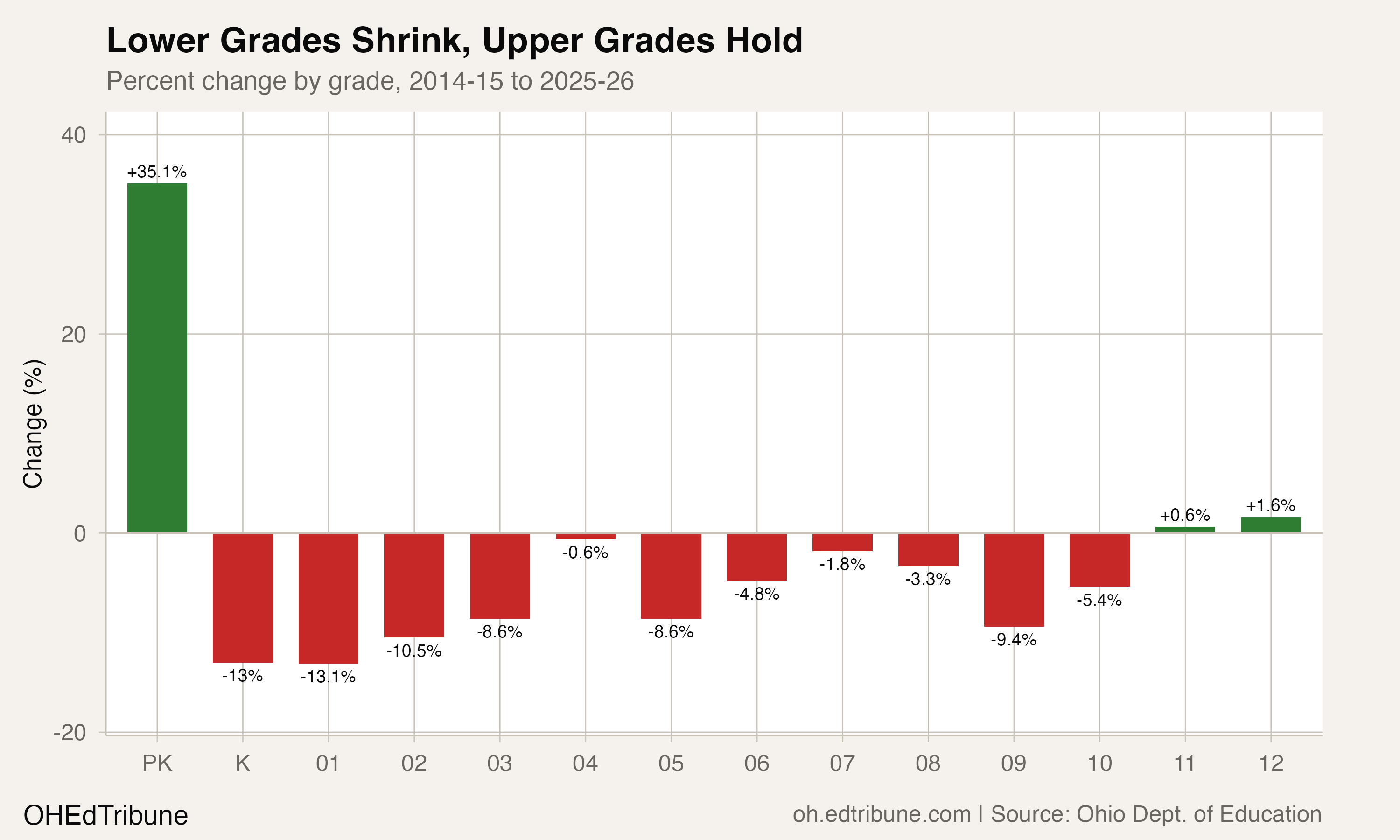
Over the full 12-year window, the losses are steepest in the earliest grades. First grade is down 13.1%, kindergarten 13.0%, second grade 10.5%. The only K-12 grades above their 2014-15 levels are 11th (+0.6%) and 12th (+1.6%). Pre-K, which grew 35.1% over the period as Ohio expanded publicly funded preschool programs, is the sole bright spot, though even PK declined 4.1% in the most recent year.
Elementary enrollment (K-5) led high school enrollment (9-12) by 195,188 students in 2014-15. That gap has compressed to 143,964 in 2025-26, a reduction of 51,224 students. When those smaller elementary cohorts reach high school in five to seven years, the gap will close further.
The urban kindergarten collapse
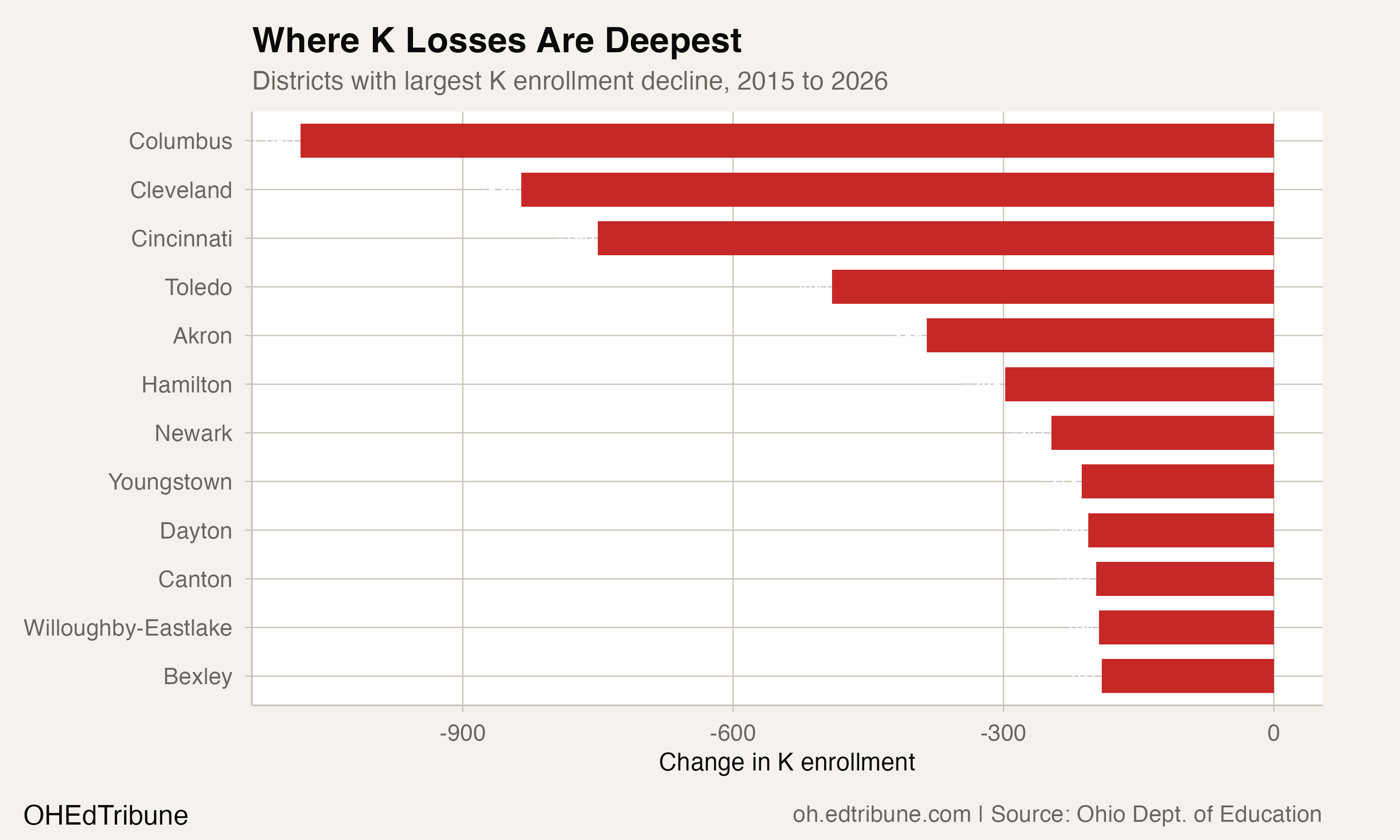
The statewide decline is broad, but it concentrates in cities. Columbus City Schools District↗ET lost 1,080 kindergartners since 2014-15, from 4,813 to 3,733, a 22.4% decline. Cleveland Municipal↗ET lost 835 (-26.8%). Cincinnati Public Schools↗ET lost 750 (-23.7%). Toledo City↗ET lost 490 (-23.9%). Youngstown City Schools↗ET lost 213, a 42.2% decline from its already small base of 505.
These five urban districts alone account for 3,368 of the statewide K decline, roughly one in five kindergartners lost. The pattern extends well beyond them. Of 700 districts with at least 20 kindergartners in 2014-15, 509 (72.7%) enrolled fewer K students in 2025-26.
A handful of suburban districts bucked the trend. Olentangy Local↗ET, in the fast-growing Delaware County suburbs north of Columbus, added 259 kindergartners (+21.1%). Pickerington↗ET added 147 (+25.7%). Dublin↗ET added 122 (+12.5%). But the gainers are outnumbered more than three to one by the losers, and their gains are modest in absolute terms compared to the urban losses.
Fewer births, more exits
The most likely driver of the kindergarten decline is demographic. Ohio's fertility rate fell 8.9% between the 2011-2020 average and 2023, according to March of Dimes data. The state recorded roughly 127,000 births in 2023, down from peaks near 150,000 a decade earlier. Since kindergartners are five-year-olds, each year's K class reflects the birth cohort from five years prior. The birth declines of 2017-2020 are now arriving in kindergarten classrooms.
School choice also plays a role, though separating it from the demographic decline is difficult. Ohio's EdChoice voucher program expanded to universal eligibility in 2023-24, growing from roughly 23,000 students to over 100,000 in two years. Some families are entering K directly at private schools using voucher funding, meaning they never appear in public school kindergarten counts. The enrollment data cannot distinguish between families that do not exist (birth decline) and families that chose a different door (school choice).
A new law will push K lower still
The kindergarten pipeline is about to face an additional headwind. House Bill 114, signed by Governor DeWine on December 19, 2025, standardizes Ohio's kindergarten cutoff date. Starting in the 2026-27 school year, all districts must admit children who turn five by the first day of school. Previously, districts could choose either August 1 or September 30 as their cutoff, meaning some children who would have been eligible under the later date will now have to wait a year.
The Ohio Legislative Service Commission estimated the law will reduce kindergarten enrollment by roughly 5,000 students annually. Applied to the current K count of 112,390, that would push the next kindergarten class below 110,000. The change does not affect the 2025-26 data analyzed here, but it means the record low documented in this article is likely to be broken within a year.
What the pipeline predicts
Elementary enrollment, currently 707,024 (K-5), is on track to fall below 680,000 within three years if the K trajectory holds. A class of 112,390 entering K in 2025-26 means approximately 112,000 first graders in 2026-27, and similarly sized cohorts advancing through every elementary grade for the rest of the decade.
Ohio's current budget provides enrollment growth supplements of $225-$250 per student for qualifying growing districts. Declining districts rely on funding "guarantee" provisions that shield them from the full fiscal impact of shrinking headcounts. As K classes contract and those guarantees come under legislative pressure, the mismatch between what districts staffed for and what they can fund will grow.
Meanwhile, House Bill 114's cutoff change is expected to remove roughly 5,000 more children from next year's kindergarten count. The 2025-26 class of 112,390 is the smallest on record. It may hold that distinction for about twelve months.
Detailed code that reproduces the analysis and figures in this article is available exclusively to EdTribune subscribers.
Discussion
Sign in to join the discussion.
Loading comments...