Ohio's public schools lost 88,804 students between 2015 and 2026. White students accounted for 202,924 of that decline, more than double the total loss itself. The math only works because every other major racial and ethnic group grew: Hispanic enrollment surged 68.4%, Asian rose 51.4%, multiracial climbed 37.7%, and Black enrollment held roughly steady at +1.0%. The state did not simply shrink. It transformed.
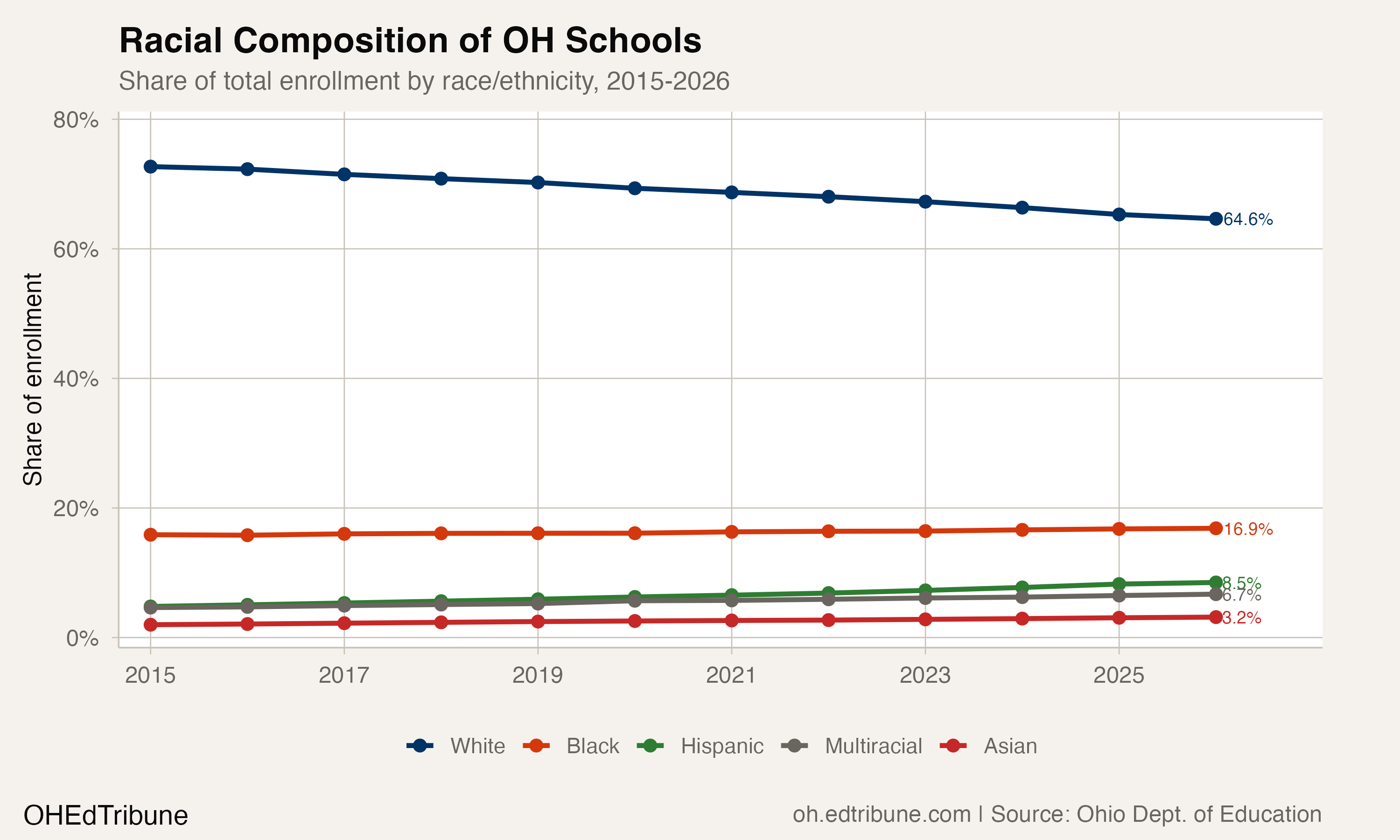
The white share of Ohio's K-12 enrollment dropped from 72.7% to 64.6% over 12 years, an 8.1 percentage-point slide that redrew the demographic profile of schools in every region of the state. Of the 578 traditional districts with comparable data across both years, 523 lost white students. Just 55 gained them.
A decline that accelerated after COVID
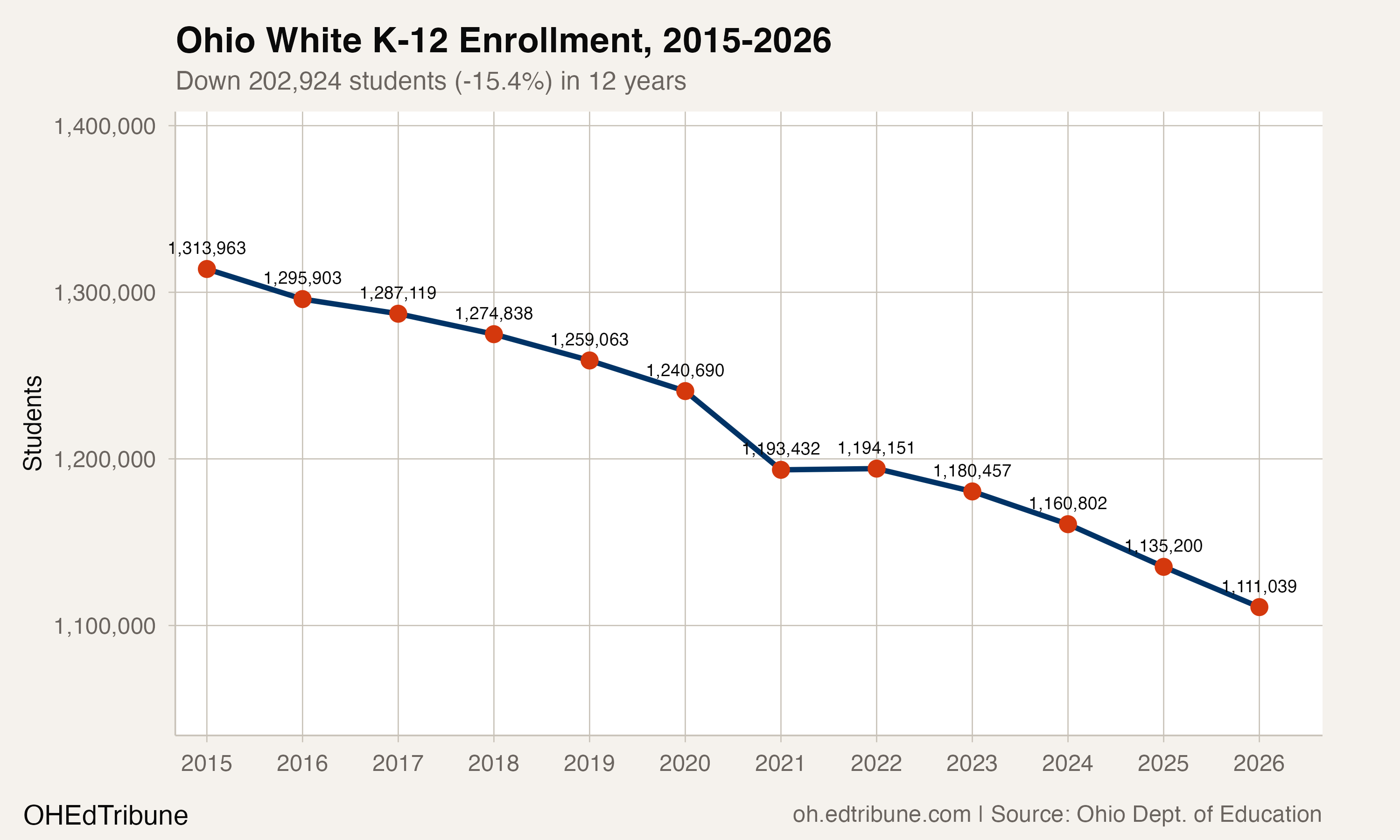
Before the pandemic, Ohio's white enrollment was falling at an average of about 14,700 students per year. That pace was steady: between 8,784 and 18,373 annually from 2016 to 2020. Then COVID hit. The 2021 school year saw a staggering 47,258 white students disappear from the rolls in a single year, a loss that dwarfed every other year in the dataset.
The brief rebound of 2022, when 719 white students returned, was the only year of gain in the entire 12-year span. It was also the last. Since 2023, the pace of white enrollment loss has averaged 20,778 per year, roughly 42% faster than the pre-COVID baseline. The two worst non-COVID years on record are 2025 (-25,602) and 2026 (-24,161), both occurring at the tail end of the series.
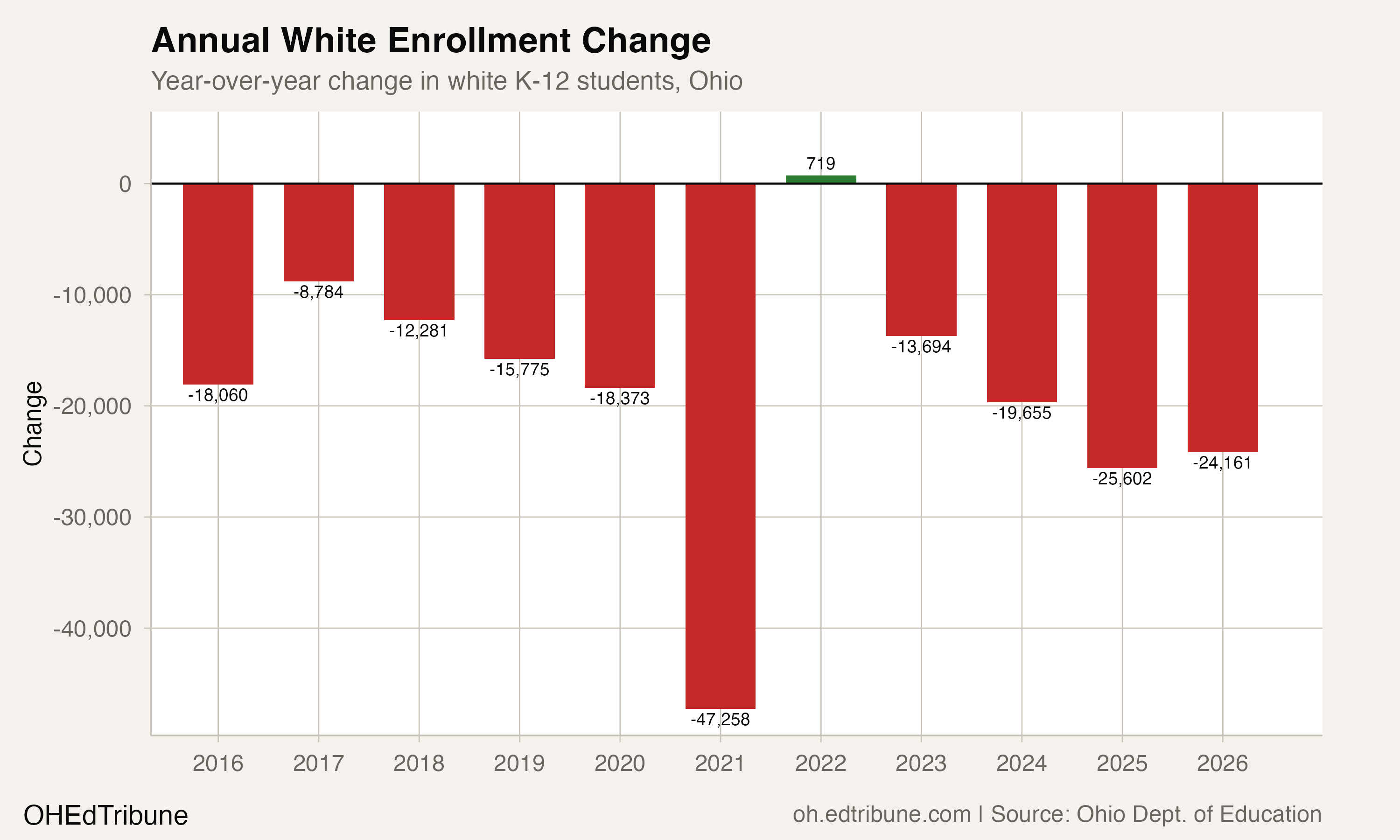
Three consecutive years of post-2022 losses above 19,000, each larger than any pre-COVID year, makes a post-pandemic overshoot hard to argue. The current pace has held for long enough that it now looks like the new baseline, not a temporary disruption.
Who grew while white enrollment shrank
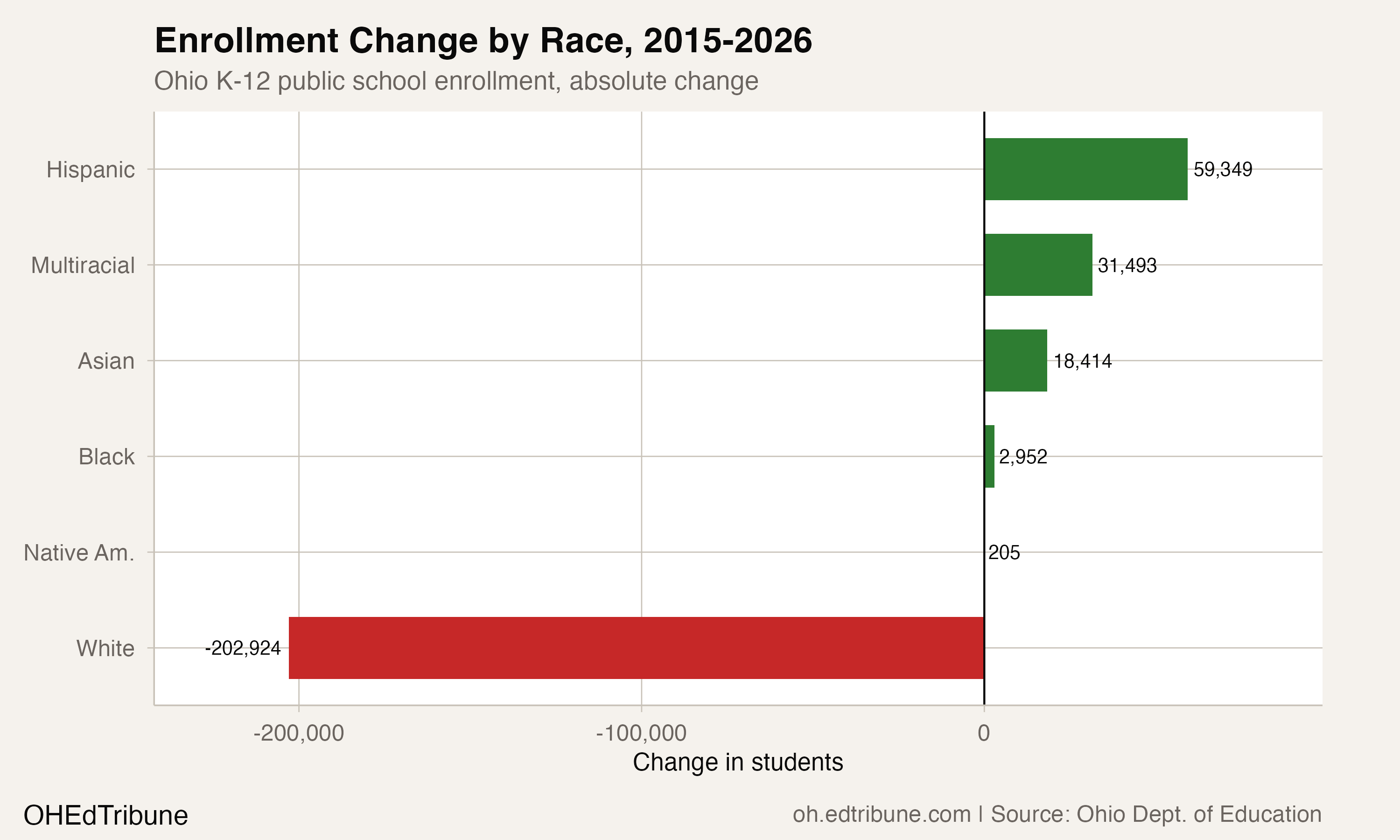
Hispanic enrollment added 59,349 students over the period, growing from 86,736 to 146,085. That 68.4% increase lifted the Hispanic share from 4.8% to 8.5% of total enrollment. In absolute terms, Hispanic growth was the largest of any group, concentrated heavily in suburban Columbus and the state's mid-sized cities. South-Western City↗ET alone added 2,062 Hispanic students. Hilliard City↗ET more than doubled its Hispanic enrollment from 1,055 to 2,175, a 106.2% increase. Olentangy Local↗ET, one of the state's fastest-growing suburban districts, saw Hispanic enrollment rise 153.0%.
Multiracial enrollment grew by 31,493 students (+37.7%), rising from 83,610 to 115,103. Multiracial students now make up 6.7% of Ohio's enrollment, up from 4.6%. Some of this growth likely reflects evolving identification patterns, as families increasingly choose multiracial categories on enrollment forms, rather than new arrivals. That distinction matters: a reclassification-driven change is real in what it reveals about identity, but it does not carry the same service implications as an influx of new students.
Asian enrollment grew 51.4%, adding 18,414 students. Black enrollment was essentially flat in absolute terms, rising by 2,952 (+1.0%), though its share of total enrollment crept up from 15.9% to 16.9% as the denominator shrank.
The urban core and inner suburbs bore the heaviest losses
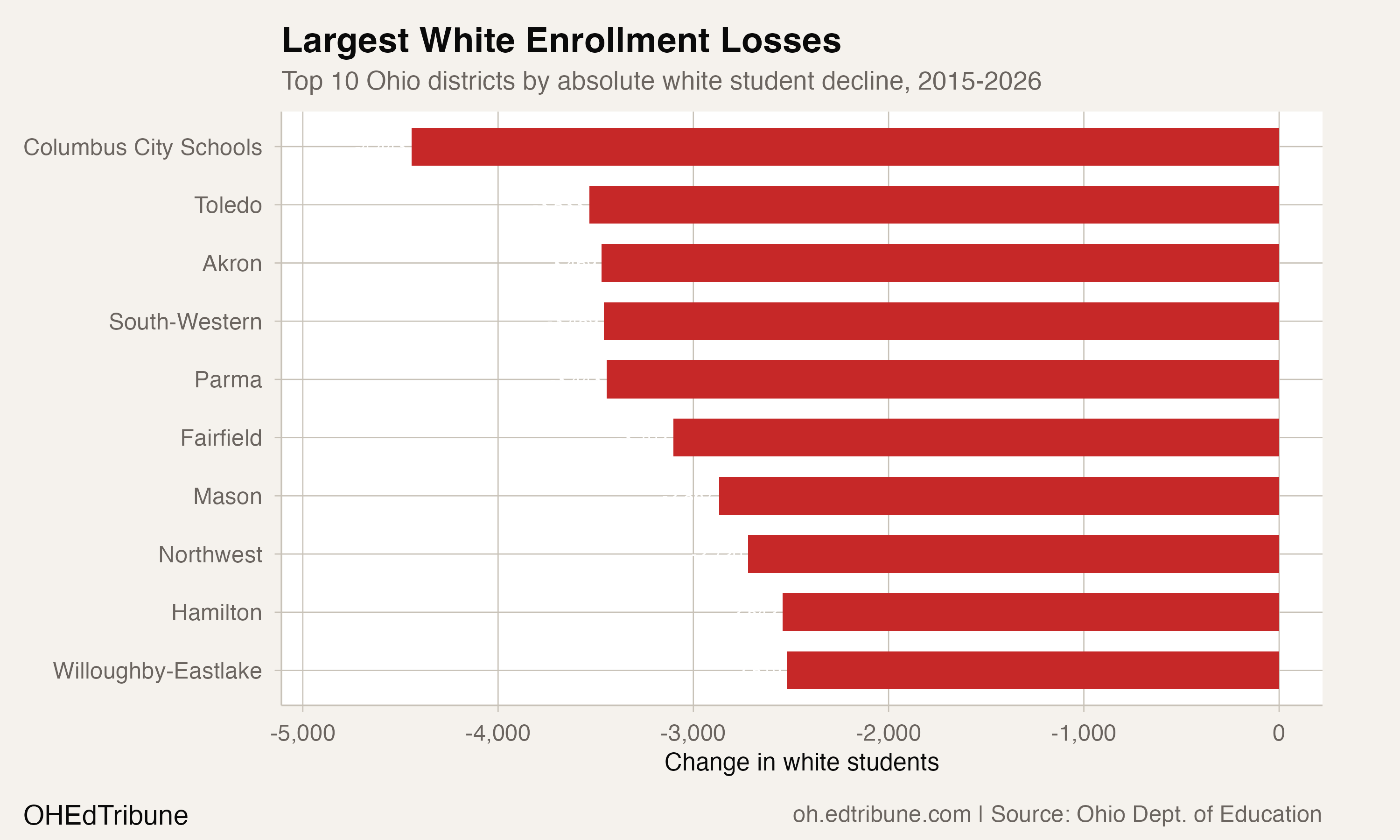
The largest absolute white enrollment losses fell on a mix of urban districts and older inner-ring suburbs. Columbus City Schools↗ET lost 4,443 white students (-35.0%), dropping from 12,680 to 8,237. Toledo↗ET lost 3,533 (-42.1%). Akron↗ET lost 3,469 (-43.4%). South-Western City↗ET, a large suburban Columbus district, lost 3,459 (-24.6%). Parma↗ET, Cleveland's largest suburb, lost 3,443 (-38.0%).
The pattern in Ohio's five largest cities is stark. White students now make up 18.0% of Columbus City Schools, down from 25.2%. In Toledo, the white share fell from 38.5% to 23.7%. In Akron, from 37.2% to 23.4%. Cincinnati Public Schools↗ET dropped from 25.2% to 20.9%. Cleveland Municipal↗ET, already the least white of the five in 2015 at 15.2%, fell to 12.4%.
Eighteen districts that were majority-white in 2015 crossed below 50% white by 2026. Licking Heights Local↗ET, east of Columbus, saw the sharpest swing: from 61.2% white to 29.0%, a 32.2 percentage-point drop in 12 years. Fairfield City↗ET, north of Cincinnati, went from 67.1% to 38.1%. South-Western City fell from 66.3% to 47.9%.
The median district lost 17.3% of its white enrollment. Only 55 districts gained any white students at all, and most of those were exurban communities on the outer edge of metro areas.
Shrinking birth cohorts and outmigration
Ohio's birth rate has declined 15.7% since 2006, according to March of Dimes data. In 2023, 126,896 babies were born in Ohio, and white non-Hispanic births accounted for roughly 70.7% of the total in the 2021-2023 period. That share, while still a majority, is lower than the 72.7% white share of school enrollment in 2015, meaning the incoming kindergarten cohorts are more diverse than the graduating 12th-grade classes they replace. Each year, a whiter class exits and a more diverse class enters. The pipeline arithmetic is relentless.
The state's overall population has barely grown. Between 2024 and 2025, deaths exceeded births by 729, according to USAFacts. Ohio's modest population increase of 39,900 that year was driven entirely by immigration, not natural growth. That immigration is disproportionately non-white, adding to the compositional shift.
School choice expansion may also play a role. In 2023, Ohio's legislature removed income limits from the EdChoice Expansion voucher program, making all families eligible for public subsidies to attend private schools. Voucher use jumped from 23,272 students to 88,095 in one year. As one superintendent told The Statehouse News Bureau:
"The students who take vouchers in our district are disproportionately not low income and disproportionately white."
The wrinkle: roughly 84% of new voucher recipients were already attending private schools. Private school enrollment grew by fewer than 3,000 students despite nearly 70,000 new scholarships. The program mostly subsidized families already outside the public system, limiting its direct enrollment impact. But it may depress future re-entry by removing the financial incentive for private-school families to return to public schools.
Columbus as the state's demographic laboratory
The Columbus metro has become the focal point of Ohio's demographic transition. Columbus City Schools lost 4,599 total students since 2015, but its Hispanic enrollment grew by 4,283 and its composition shifted sharply. The surrounding suburbs show the same pattern at different speeds: Dublin City↗ET lost only 200 white students (-2.0%) while adding 626 Hispanic students. Hilliard City lost 1,595 white students but gained 1,120 Hispanic students.
Columbus's foreign-born population has grown substantially. Between July 2023 and July 2024, more than 20,000 immigrants moved to Franklin County, with immigration accounting for 54% of all county growth. The city's 15.1% foreign-born share is nearly triple the state average of 5.3%. Established Somali, Haitian, and other immigrant communities in Columbus have expanded, adding students to public schools even as white enrollment contracts.
Whether that immigration-fueled growth can offset the broader state decline is uncertain. An Ohio Capital Journal analysis warned that federal immigration restrictions could threaten the state's modest population gains, noting that net immigration into the United States dropped from 2.7 million in 2024 to 1.3 million in 2025. If that trend continues, the one source of enrollment growth Ohio has left could weaken.
What to watch next
In 2015, eighteen districts were majority-white and on the cusp of crossing below 50%. All eighteen have now crossed. Fairfield City went from 67% white to 38%. South-Western City dropped from 66% to 48%. Licking Heights, once 61% white, is now 29%. These are not distant projections — they are transformations that already happened, in suburbs where the yard signs and the sports rosters and the PTA meetings look nothing like they did a decade ago.
The EdChoice voucher program, now uncapped by income, may accelerate the shift further. Ohio superintendents report that voucher recipients skew white and non-low-income — families subsidized to leave a system they had already chosen to leave. The public school system they leave behind is increasingly Hispanic, increasingly Asian, and increasingly reliant on those growing populations to slow a total enrollment decline that shows no sign of bottoming out.
Detailed code that reproduces the analysis and figures in this article is available exclusively to EdTribune subscribers.
Discussion
Sign in to join the discussion.
Loading comments...