Correction (May 29, 2026): An earlier draft of this article reported district recovery rates by size band (76.2%, 71.7%, 53.1%, and 47.1%) computed on an inconsistent basis. The corrected figures, computed on the same 2026-enrollment basis as the statewide district counts, appear below.
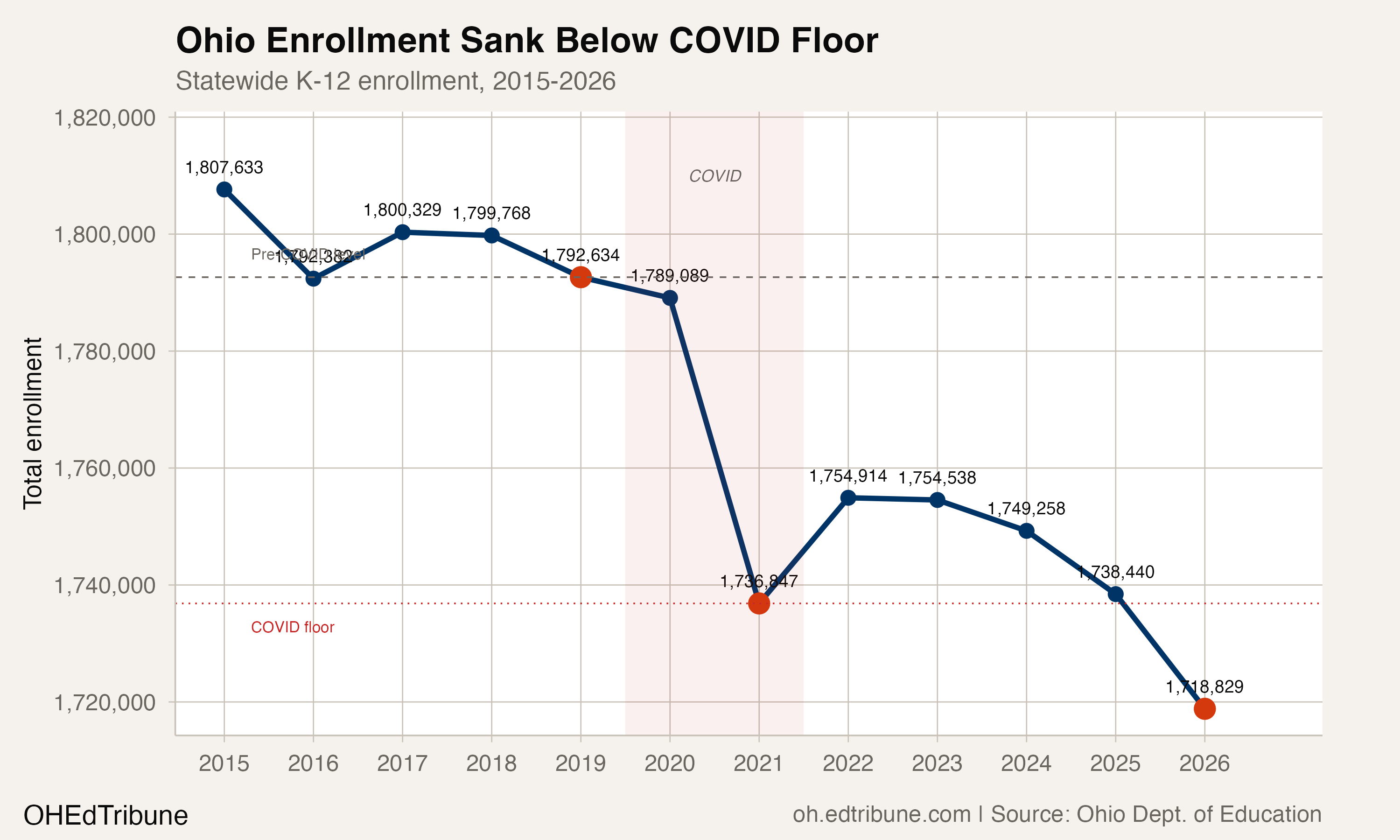
Ohio's public school enrollment bottomed out during the pandemic at 1,736,847 students. That was supposed to be the floor. Five years later, it is 18,018 students below that floor and still falling.
The state enrolled 1,718,829 students in 2025-26, down 73,805 from its pre-COVID count of 1,792,634, a 4.1% decline. The 2025-26 loss alone, 19,611 students, is the largest single-year drop outside the pandemic itself. Ohio is not recovering from COVID. It is accelerating away from it.
The bounce that vanished
The trajectory since 2021 tells the story in four acts. In 2021-22, Ohio posted a strong bounce-back of 18,067 students, recovering about a third of the pandemic's 55,787-student loss. It looked like the beginning of a return to normal.
Then the gains evaporated. The state lost 376 students the following year, 5,280 the year after, 10,818 the year after that, and 19,611 in 2025-26. Each year's loss has been larger than the last, a staircase descending at an increasingly steep angle.
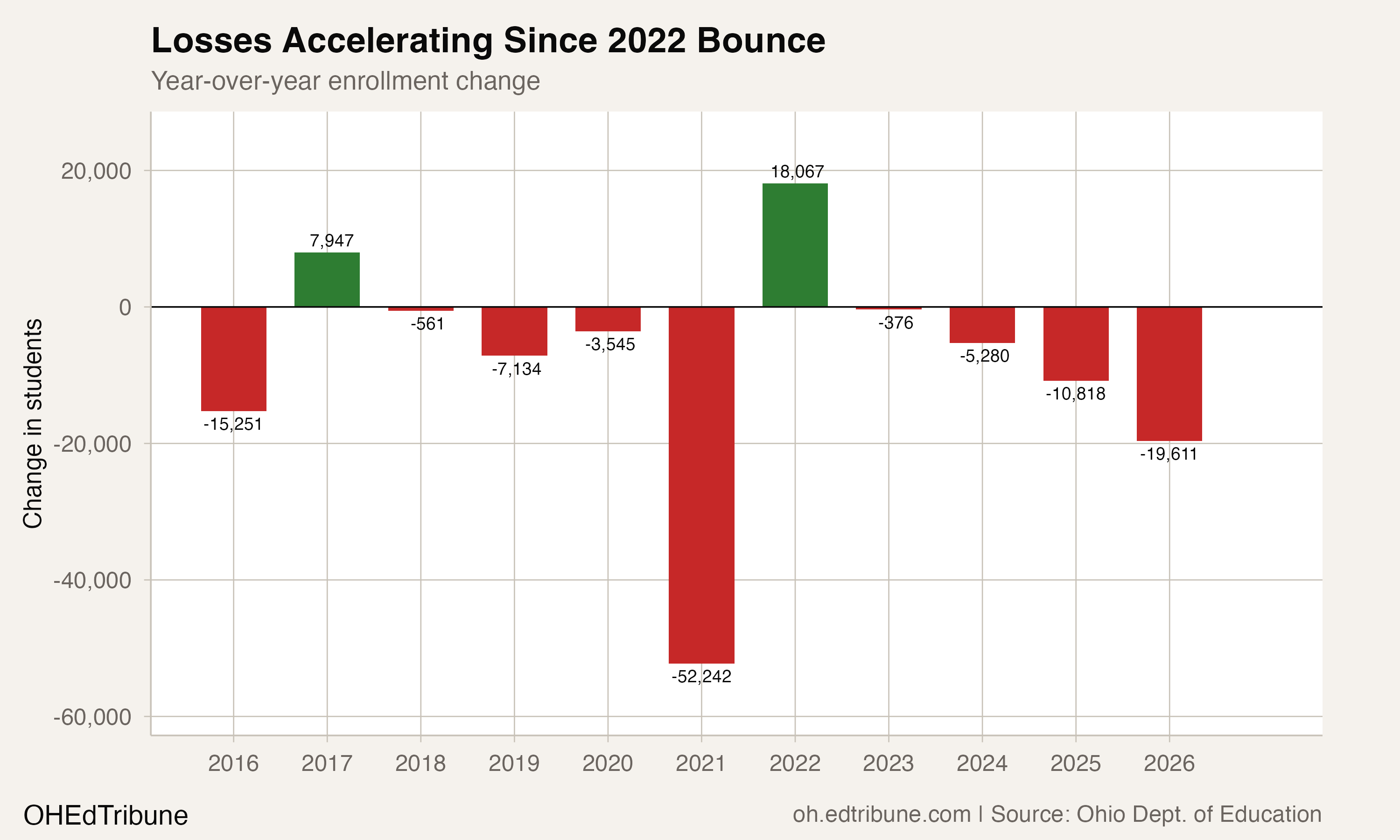
The 2025-26 drop is more than five times the size of the pre-pandemic average annual loss of roughly 3,750 students per year from 2015 to 2019. What was once a slow demographic leak has become a structural drain.
Where 148,000 white students went
The racial composition of the decline is stark. Since 2019, white enrollment has fallen by 148,024 students, an 11.8% drop that accounts for 200% of the total statewide loss. Ohio's white share of enrollment fell from 70.2% to 64.6% over the same period.
Every other racial group grew. Hispanic enrollment rose 37.8%, adding 40,072 students. Multiracial enrollment climbed 22.5% (+21,119). Asian enrollment grew 22.6% (+10,001). Black enrollment was essentially flat, adding 1,299 students (0.5%).
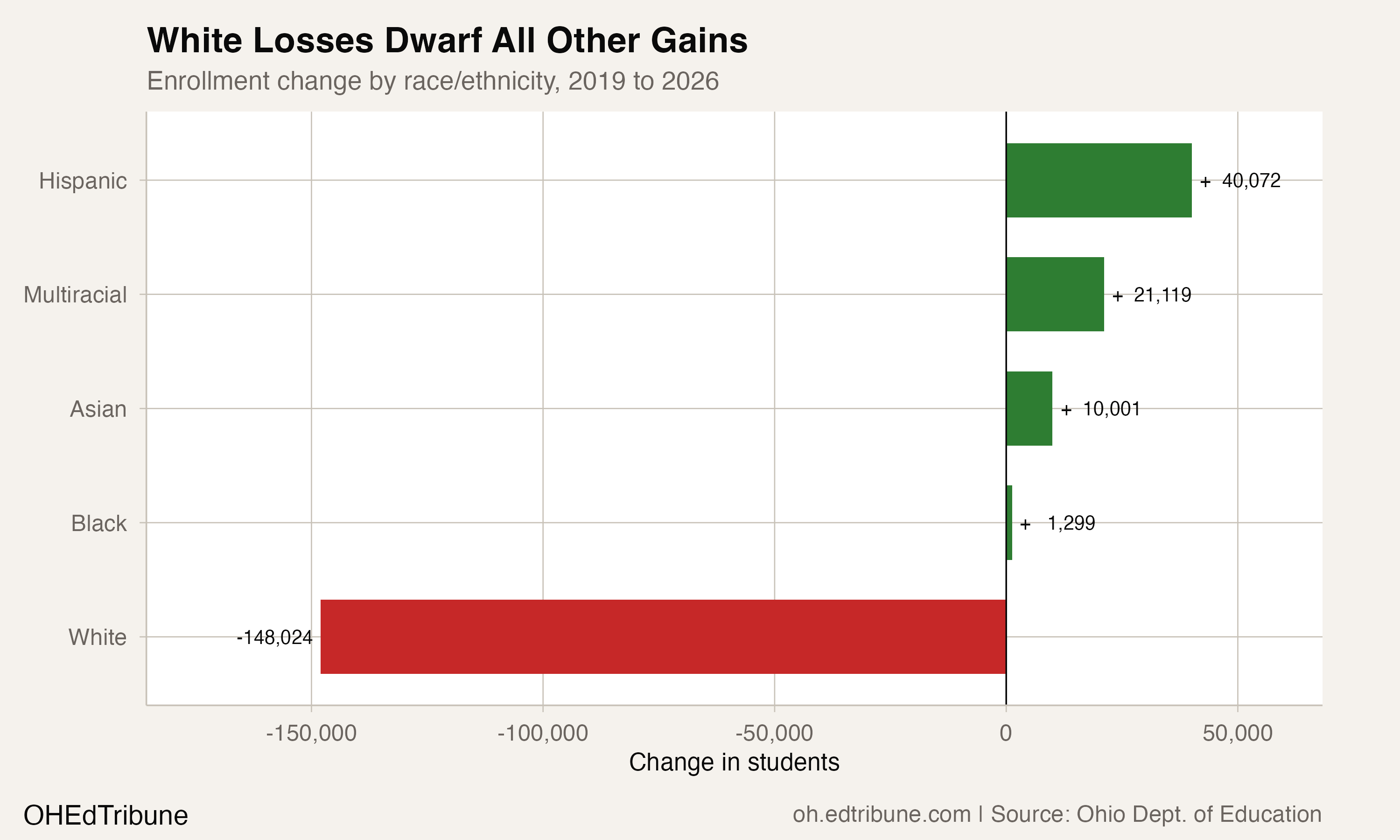
The gains from non-white groups, totaling 72,491 students, offset nearly half the white losses. But they cannot offset the scale: Ohio would need to add 148,024 non-white students just to hold enrollment steady, and it has added roughly half that.
Ohio's birth rate dropped 15.7% since 2006, and the state's overall population is projected to decline by 675,000 residents by 2050, according to the Ohio Department of Development. The enrollment pipeline is narrowing at the entry point: kindergarten enrollment fell 9.7% since 2019, from 124,427 to 112,390 students. Fewer children are being born, and fewer are entering the public system.
Two in three districts below their pandemic floor
The statewide number masks the breadth of district-level failure to recover. Of 841 districts with comparable data across 2019, 2021, and 2026, 539 (64.1%) now sit below their own COVID-era low point. Only 208 districts (24.7%) have returned to pre-pandemic enrollment. The remaining 94 (11.2%) recovered partially, climbing above their COVID floor but not back to 2019 levels.
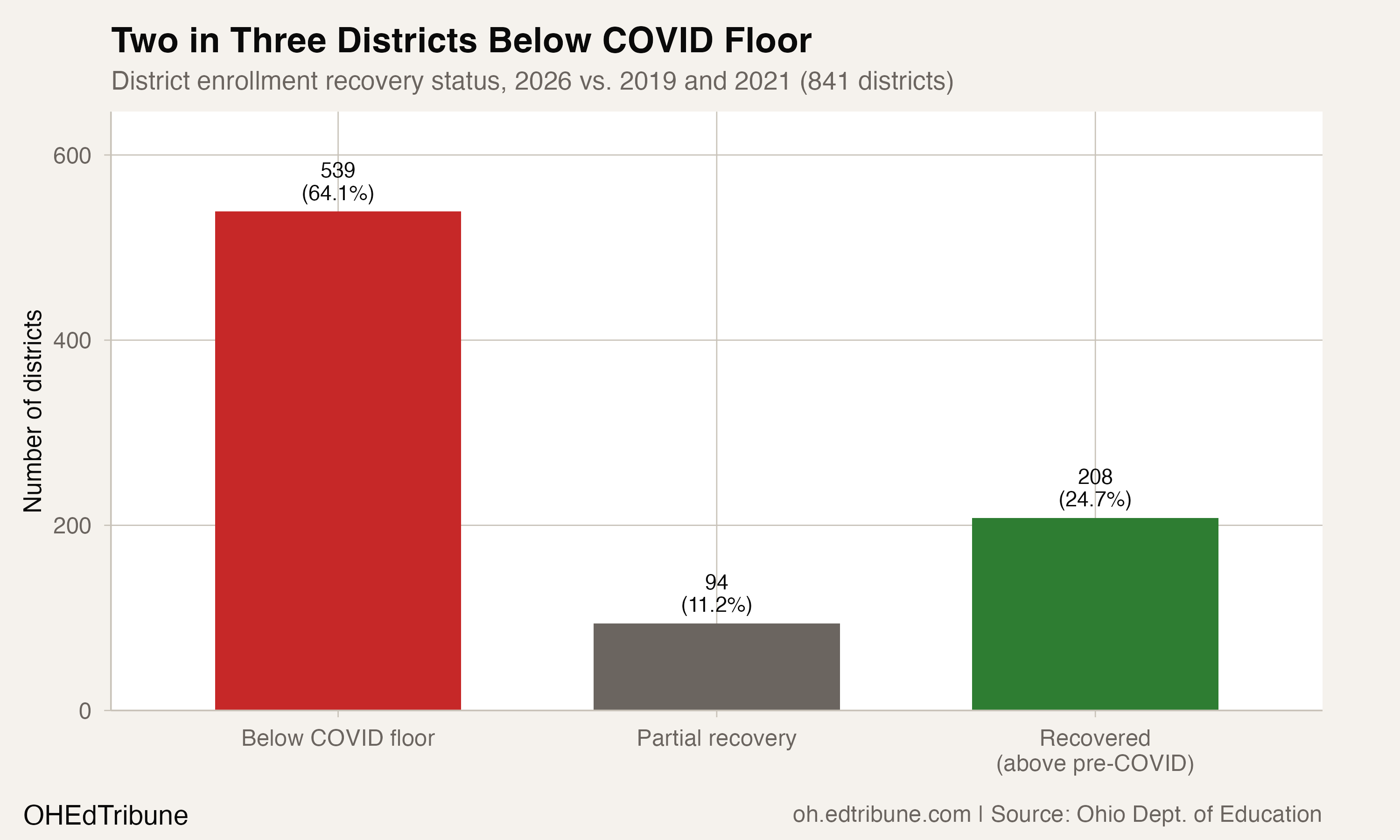
The pain is not evenly distributed by size. Mid-sized districts in the 1,000 to 5,000 range have the worst recovery rates: 76.9% of them sit below their COVID floor, the highest of any size band. The smallest districts (under 1,000) and the next tier up (5,000 to 10,000) land close together, at 61.4% and 60.9% below their floor. The largest districts (over 10,000) fare best, with exactly half below their pandemic low.
The big five: urban anchors still sinking
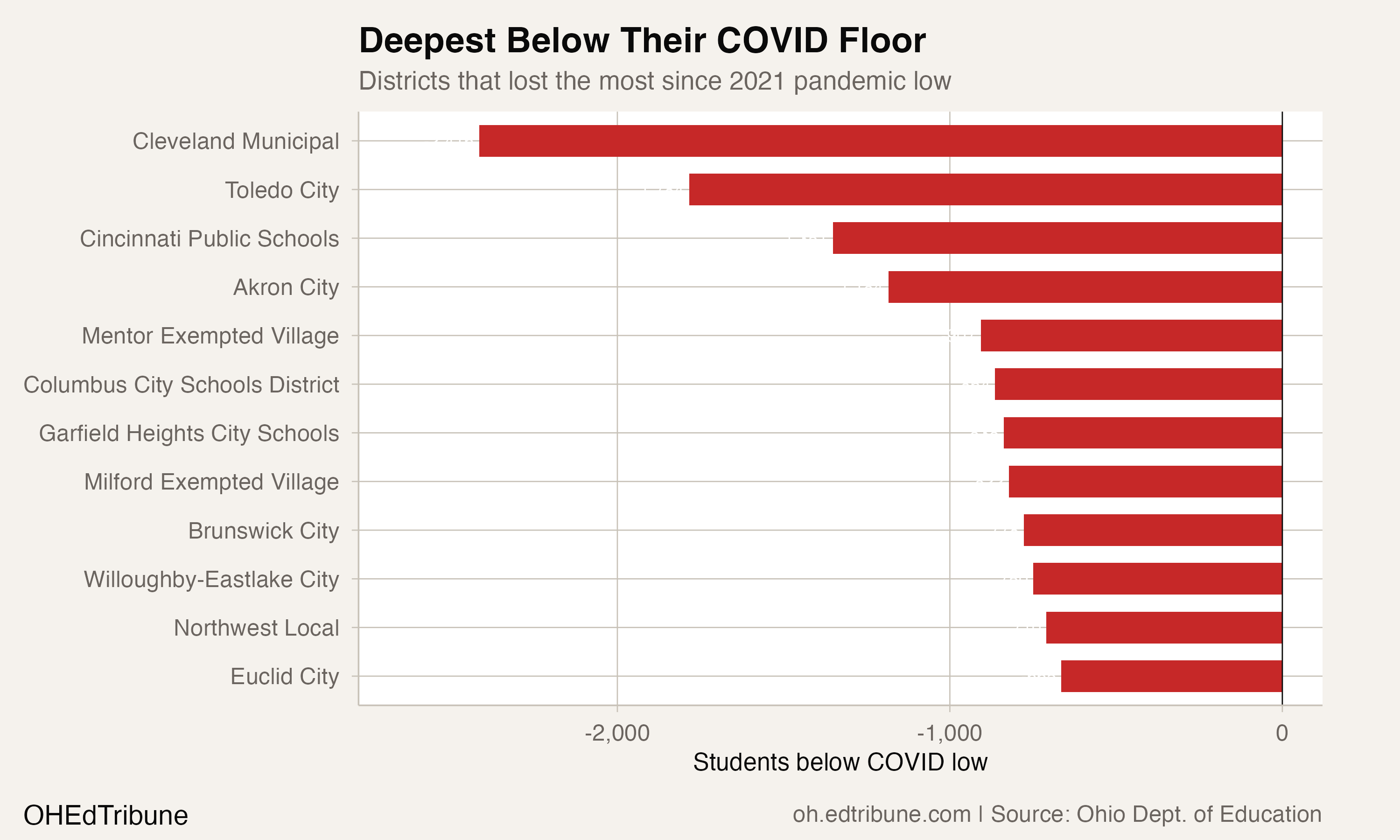
Ohio's five largest urban districts account for a disproportionate share of the decline. Cleveland Municipal↗ET has lost 5,265 students since 2019 (14.0%) and sits 2,416 below its COVID floor. The district approved closing or merging 29 of its 88 schools by the 2026-27 school year, a consolidation driven by enrollment that has fallen roughly 50% since 2004.
Columbus City Schools District↗ET lost 3,204 students (6.5%) and is considering shuttering up to 20 of 112 school buildings. Superintendent Angela Chapman framed the calculus:
"We are spending more of our financial resources on facilities, operations and maintenance of buildings than we are on instruction." -- The Ohio Newsroom, June 2024
Toledo City↗ET lost 2,792 students (12.0%) and is 1,784 below its pandemic floor, the second-deepest slide among large districts. Akron City↗ET lost 1,929 (9.1%). Cincinnati Public Schools↗ET lost 1,562 (4.5%) but sits 1,351 below its COVID low, meaning nearly all of its post-pandemic loss came after the initial drop.
The one exception among the state's largest cities: Dayton City gained 267 students (2.1%) since 2019.
The school choice factor
The expansion of Ohio's EdChoice voucher program in summer 2023, which removed income limits and made all families eligible regardless of income, introduced a new variable. Voucher usage surged from 69,675 students in 2020-21 to 166,589 in 2024-25, according to state data. Homeschooling also reached roughly 61,000 students in 2024-25, about 3% of all students.
But the voucher expansion's direct impact on public enrollment is smaller than the raw numbers suggest. A Policy Matters Ohio analysis found that in 2024, the state distributed nearly 70,000 new EdChoice Expansion vouchers, yet private school enrollment grew by fewer than 3,000 students. Most vouchers went to families already paying for private school who became newly eligible for public subsidies. The fiscal impact is real: Ohio's five voucher programs cost $966.2 million in 2023-24. The enrollment impact is harder to isolate.
Montgomery County ESC Superintendent Shannon Cox captured the broader uncertainty:
"So where did they go? We're not really sure." -- Dayton Daily News
Multiple forces are pulling in the same direction: birth rate decline, population outmigration, expanded school choice options, and persistent non-return from pandemic-era alternatives. No single factor explains the entire gap, but together they create a compounding effect that shows no sign of reversing.
Suburban growth pockets
Not every district is losing. Olentangy Local↗ET in Delaware County added 2,785 students (12.9%) since 2019 and now enrolls 24,362. Pickerington Local gained 1,198 (11.2%). Southwest Licking Local grew 19.3%. These districts share a common profile: outer-ring suburban locations in the Columbus metro area, absorbing residential development that bypasses the urban core.
But suburban growth districts represent a shrinking minority. Three in four districts have not returned to their pre-pandemic enrollment, and the statewide trend line is bending further downward each year.
Five years on, and still sinking
The losses have grown four years running, from 376 to 5,280 to 10,818 to 19,611. That run has erased not just the post-COVID recovery but the idea that recovery was the right frame. COVID did not cause Ohio's enrollment decline. It interrupted a decline that was already underway and briefly masked it with one bounce-back year. The underlying forces, fewer births and a flat population, have since resumed at double the pre-pandemic pace.
Aaron Churchill, Ohio research fellow at the Fordham Institute, put it simply: "All the demographic factors with reduced childbirth rates, sort of a stagnant general population in Ohio just means there are fewer kids to educate."
Cleveland is closing 29 schools. Columbus just cut $50 million. Montgomery County's superintendent told the Dayton Daily News, "So where did they go? We're not really sure." For the 539 districts now below their pandemic floor, the answer matters less than the math: per-pupil funding follows students out the door, and Ohio has 73,805 fewer of them than it did when the pandemic started.
Detailed code that reproduces the analysis and figures in this article is available exclusively to EdTribune subscribers.
Discussion
Sign in to join the discussion.
Loading comments...