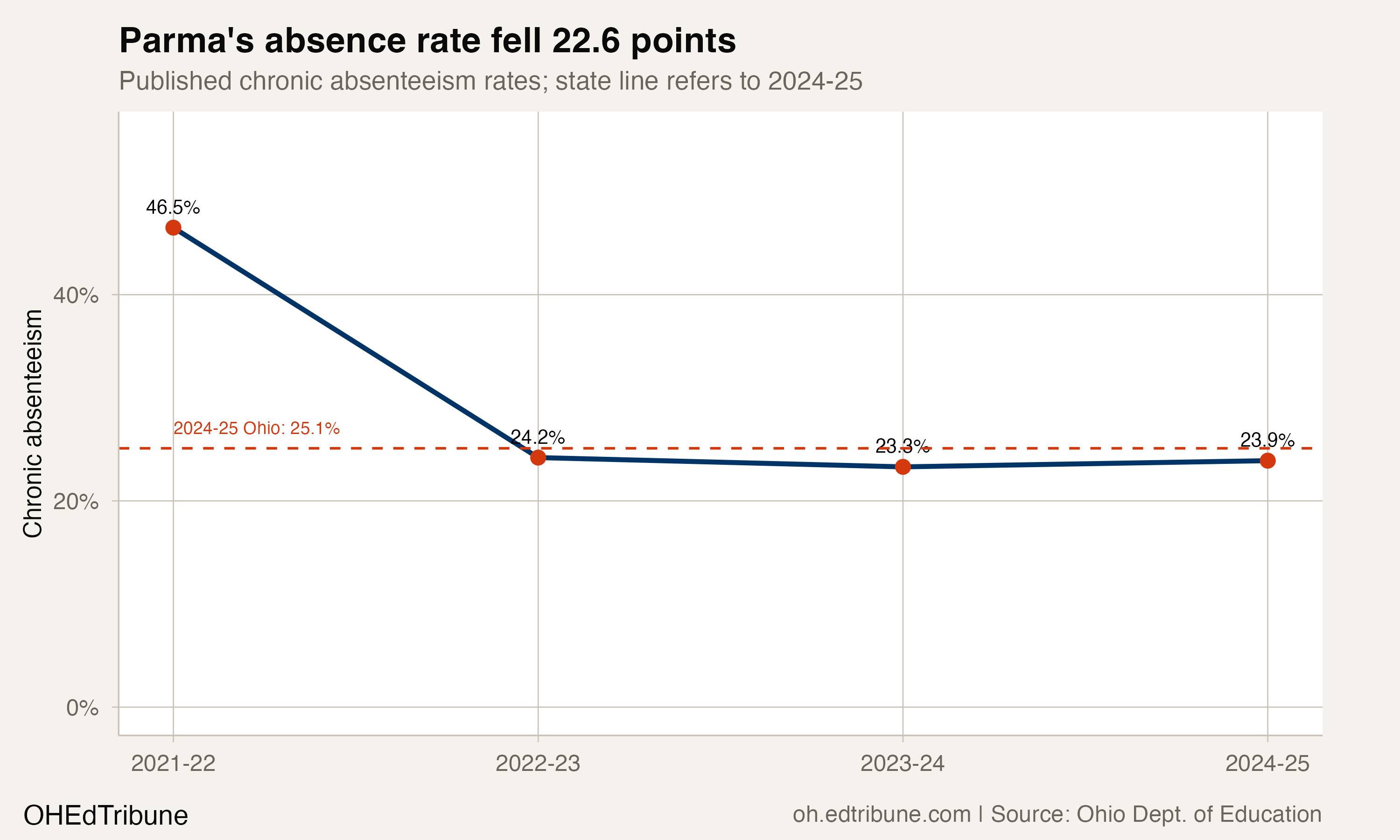
Parma City↗ET School District's published chronic absenteeism rate fell from 46.5% in 2021-22 to 23.9% in 2024-25, a decrease of 22.6 percentage points. By the end of that comparison, Parma was below Ohio's corresponding statewide rate of 25.1%.
The improvement was concentrated in the first year after the high starting rate. Parma's rate fell to 24.2% in 2022-23, then stood at 23.3% in 2023-24 before rising slightly in 2024-25. These are historical attendance results, not a measure of students' attendance this fall.
A sharp decrease, followed by a smaller range
The initial decline was 22.3 percentage points. Most of the reduction between the first and last reports therefore occurred between 2021-22 and 2022-23. The subsequent rates stayed below a quarter of students, rather than continuing to fall at the same pace.
That is a more precise description than a continuous improvement streak. Parma's rate improved again in 2023-24 and then increased in 2024-25. The latest result still left the district substantially below its starting rate, but the small reversal belongs in the account of what happened.
The statewide rate also declined across the comparison, from 30.2% in 2021-22 to 25.1% in 2024-25. Parma moved from above that statewide rate to below it. In the last published year used here, Parma's rate was 1.2 percentage points lower than Ohio's.
The largest decrease in the qualifying comparison
Parma had the largest endpoint decrease among the 420 districts meeting the enrollment and data-availability rules shown in the comparison chart. The analysis compares the same districts' first and last published rates and uses their last-year enrollment to determine eligibility. It does not rank schools, or districts without both endpoint rates, alongside them.
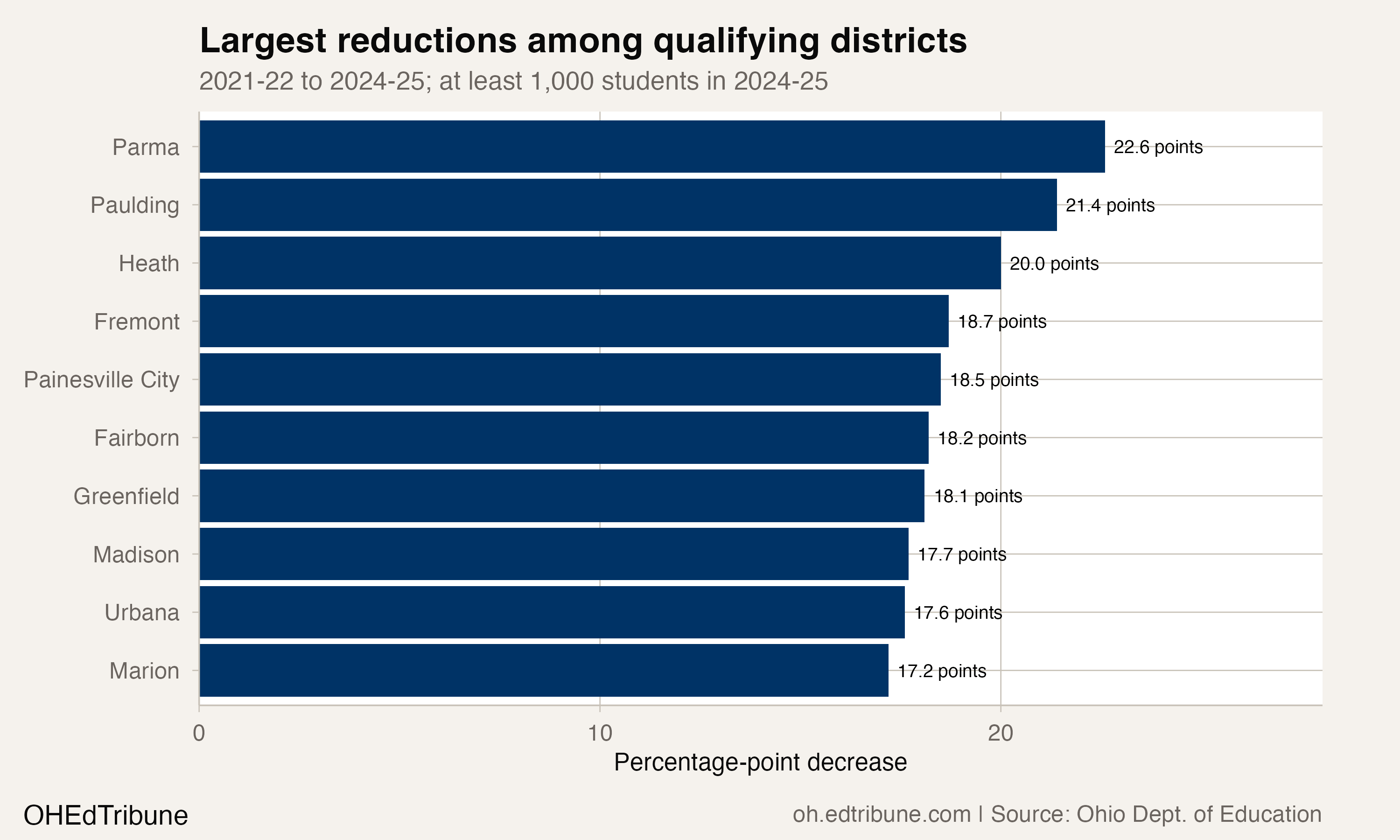
This is a ranking of decreases, not a ranking of the lowest absence rates. A district can show a large decrease while retaining a comparatively high rate. Parma's own result also leaves a substantial attendance problem: its final rate was just under a quarter of students.
The endpoint ranking cannot explain the change. Attendance initiatives, changes in family circumstances and differences in reporting are questions for district evidence. The state rate series records the results; it does not establish which intervention produced them or how much of the initial decrease reflects circumstances shared across Ohio.
Nearby districts followed different paths
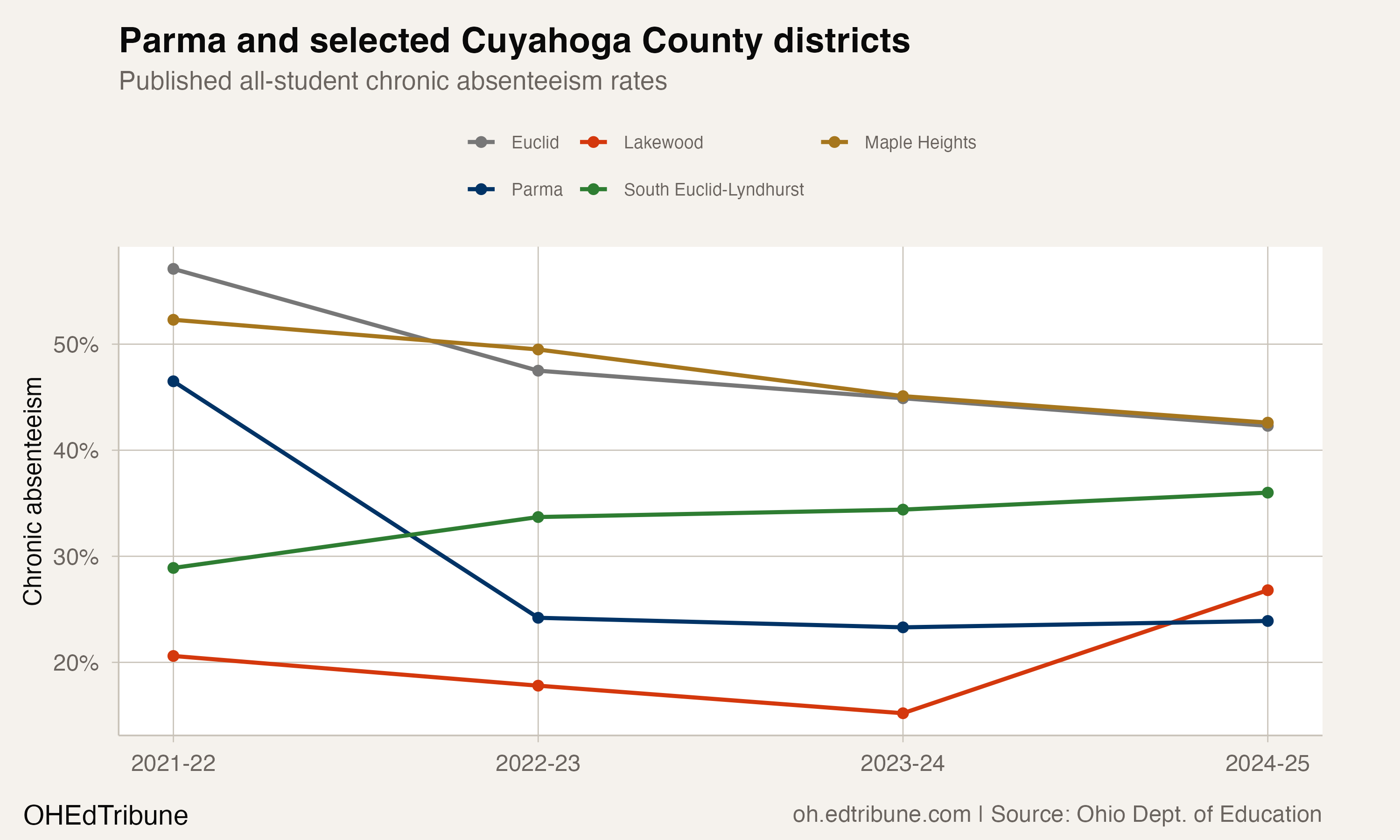
The selected Cuyahoga County comparison shows why it is useful to examine annual rates as well as endpoint changes. Lakewood City↗ET moved from 20.6% in 2021-22 to 26.8% in 2024-25. South Euclid-Lyndhurst City↗ET rose from 28.9% to 36.0%.
Other selected districts improved while finishing above Parma. Euclid City↗ET fell from 57.1% to 42.3%, and Maple Heights City↗ET fell from 52.3% to 42.6%. These districts illustrate different paths within the same reporting window; they are not a matched comparison that isolates a Parma policy effect.
What the record can establish
The available state absence series starts in 2021-22. It cannot establish whether Parma or these nearby districts have returned to a pre-pandemic baseline. It also does not turn total district enrollment into a count of students attending regularly; that is a different measure.
The supported finding is substantial on its own: Parma's rate fell sharply, remained well below its starting level in the following reports, and finished below the corresponding Ohio rate. The next useful question is whether the later, smaller fluctuation continues—and what district evidence can explain the initial change.
Detailed code that reproduces the analysis and figures in this article is available exclusively to EdTribune subscribers.
Discussion
Sign in to join the discussion.
Loading comments...