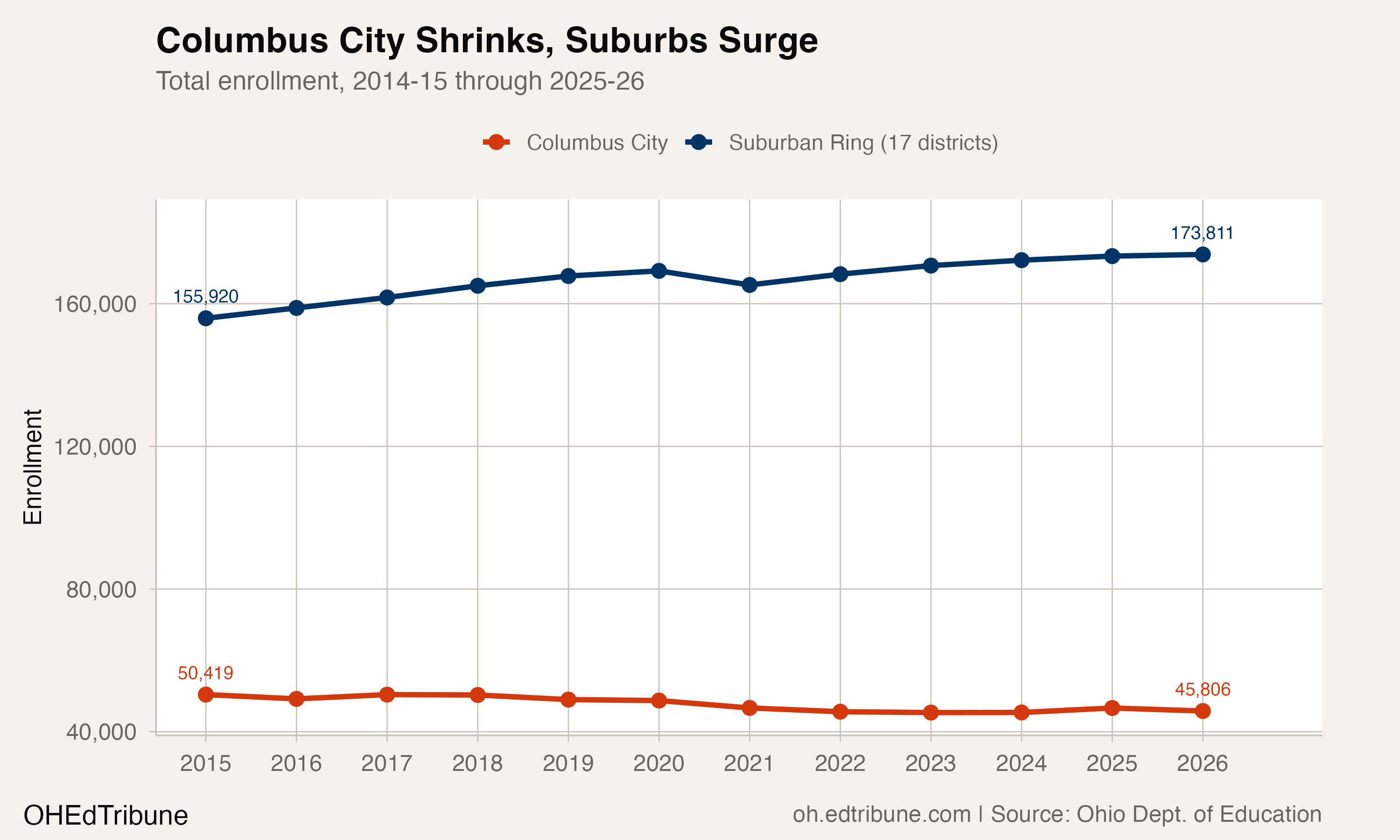
For every student Columbus City Schools↗ET lost over the past 11 years, the ring of suburbs around it gained nearly four.
The state's largest traditional district shed 4,613 students between 2014-15 and 2025-26, a 9.1% decline that left it at 45,806 students. During that same period, 17 suburban districts in the Columbus metropolitan area collectively added 17,891 students, an 11.5% gain that pushed their combined enrollment to 173,811. The suburban ring now enrolls 3.8 students for every one in the city district, up from 3.1 a decade ago.
The result is a textbook donut pattern, one visible in cities across Ohio and the Midwest. Columbus is hollowing out while the ring thickens. The gap between city and suburb, already wide in 2015, has widened by more than 22,000 students.
The ring's biggest winners
Olentangy Local↗ET, which serves southern Delaware County, is the dominant force. The district added 5,349 students over 11 years, a 28.1% increase that brought total enrollment to 24,406. That makes Olentangy the fourth-largest traditional district in Ohio, behind only Columbus, Cincinnati, and Cleveland.
The growth is not slowing down. Olentangy has added students in 10 of the 11 years since 2015, and voters approved a $235 million bond issue in November 2025 to build a fifth high school and an eighteenth elementary school. Enrollment projections anticipate the district will reach 28,337 by 2035-36.
"Ohio law does not allow impact fees on developers, unlike states like Florida." — Deputy Superintendent Dr. Jack Fette, ABC6 Columbus, Sept. 2025
That single constraint explains much of the bond politics. Residential construction in Delaware County has accelerated, and the county is the 22nd fastest-growing in the nation by percentage of population growth. The county's school enrollment rose 22.4% over the same period, from 29,870 to 36,558 students. Developers build; districts absorb the cost.
Seven other districts posted gains exceeding 1,000 students, among them Dublin City↗ET (+1,971, +13.1%), Pickerington Local↗ET (+1,641, +16.1%), Licking Heights Local↗ET (+1,409, +36.6%), Southwest Licking Local↗ET (+1,167, +30.2%), and Gahanna-Jefferson City↗ET (+1,071, +14.7%). Even smaller-base districts like Big Walnut Local↗ET grew 30.8%, adding 1,008 students.
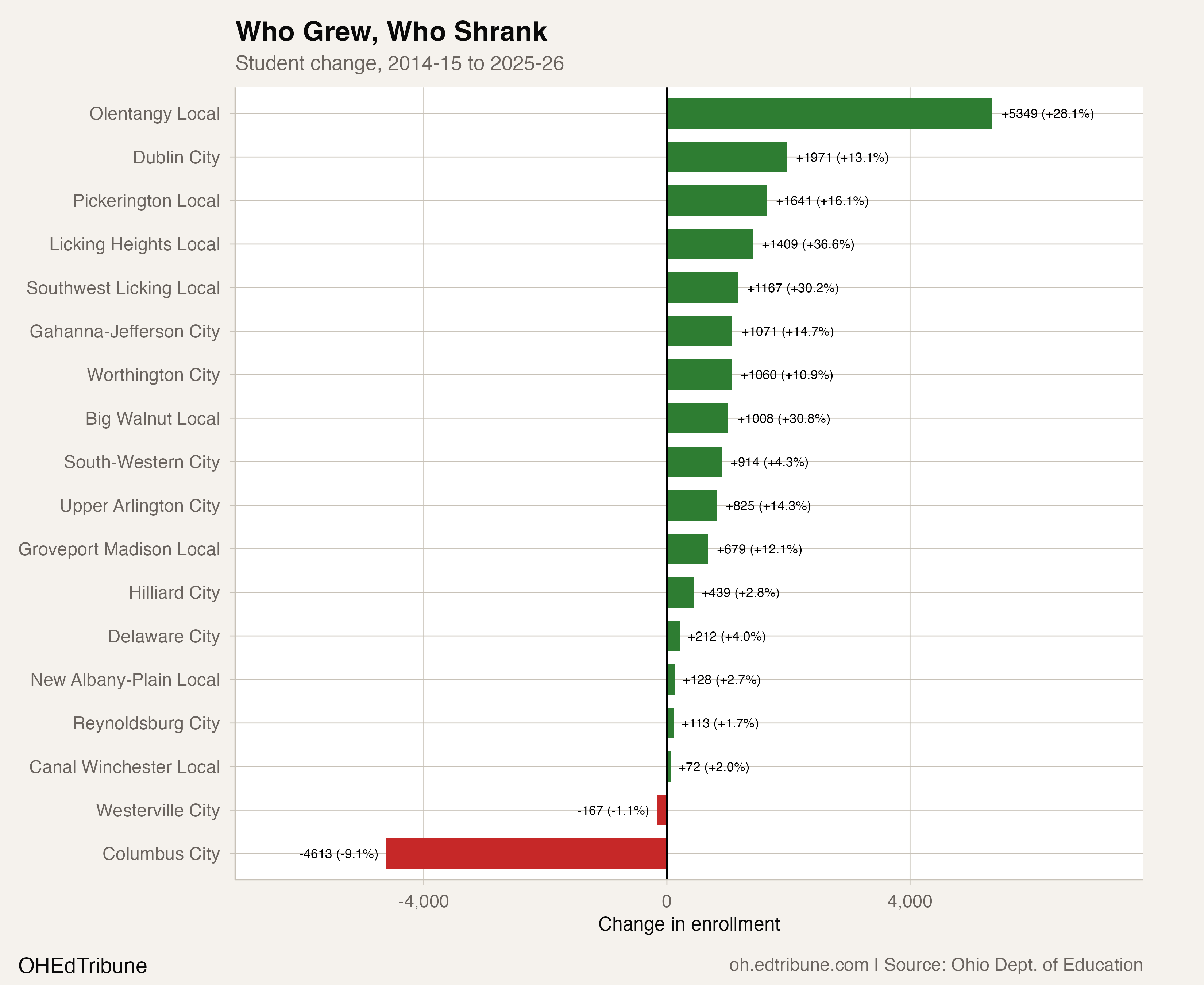
Only two of the 18 districts in the metro tracked here lost enrollment. Westerville City↗ET dipped by 167 students (-1.1%), a rounding error across 11 years. Columbus City's loss of 4,613 students stands alone in magnitude.
A $50 million hole in the center
Columbus City Schools' enrollment decline has translated directly into fiscal pressure. In December 2025, the board approved $50.4 million in budget cuts, including the elimination of more than 60 administrator positions and the closure of four schools. Those closures follow five additional schools already shuttered at the end of the prior school year.
The building-level numbers illustrate the mismatch between capacity and enrollment. Fifteen campuses operate below 60% utilization, and 21 more sit between 60% and 70%. Together, that represents roughly a third of the district's buildings.
"We've only begun to cut the budget. This is a starting point. But it could get worse if the White House and Ohio Legislature continue to cut and defund public education." — Superintendent Angela Chapman, WOSU, Oct. 2025
The district's grade-level data shows where the pipeline is thinning. First through third grade enrollment dropped by 799, 826, and 920 students respectively since 2015. High school grades have partially offset this, with ninth grade adding 167 students. The elementary decline foreshadows further contraction as those smaller cohorts move through the system.
Charter competition compounds the picture. Franklin County had 79 community schools enrolling 36,006 students in 2015. By 2026, 84 community schools enrolled 32,959, a modest decline in the charter sector itself, though individual charter networks have grown. Columbus City remains one of the most competition-exposed districts in the country, facing student outflows to charters, open-enrollment transfers, and EdChoice vouchers simultaneously.
The diversity wave hits the suburbs
The donut story is not just about headcounts. The demographic composition of the suburban ring is transforming at a pace that would have seemed improbable a decade ago.
In 2015, two of the 17 suburban districts tracked here had majority-minority student bodies: Groveport Madison Local↗ET (47.9% white) and Reynoldsburg City↗ET (44.0% white). By 2026, seven suburbs have crossed that threshold. Westerville (48.1% white), Pickerington (39.6%), South-Western City↗ET (47.9%), Canal Winchester Local↗ET (46.1%), and Licking Heights (29.0%) all joined the list.
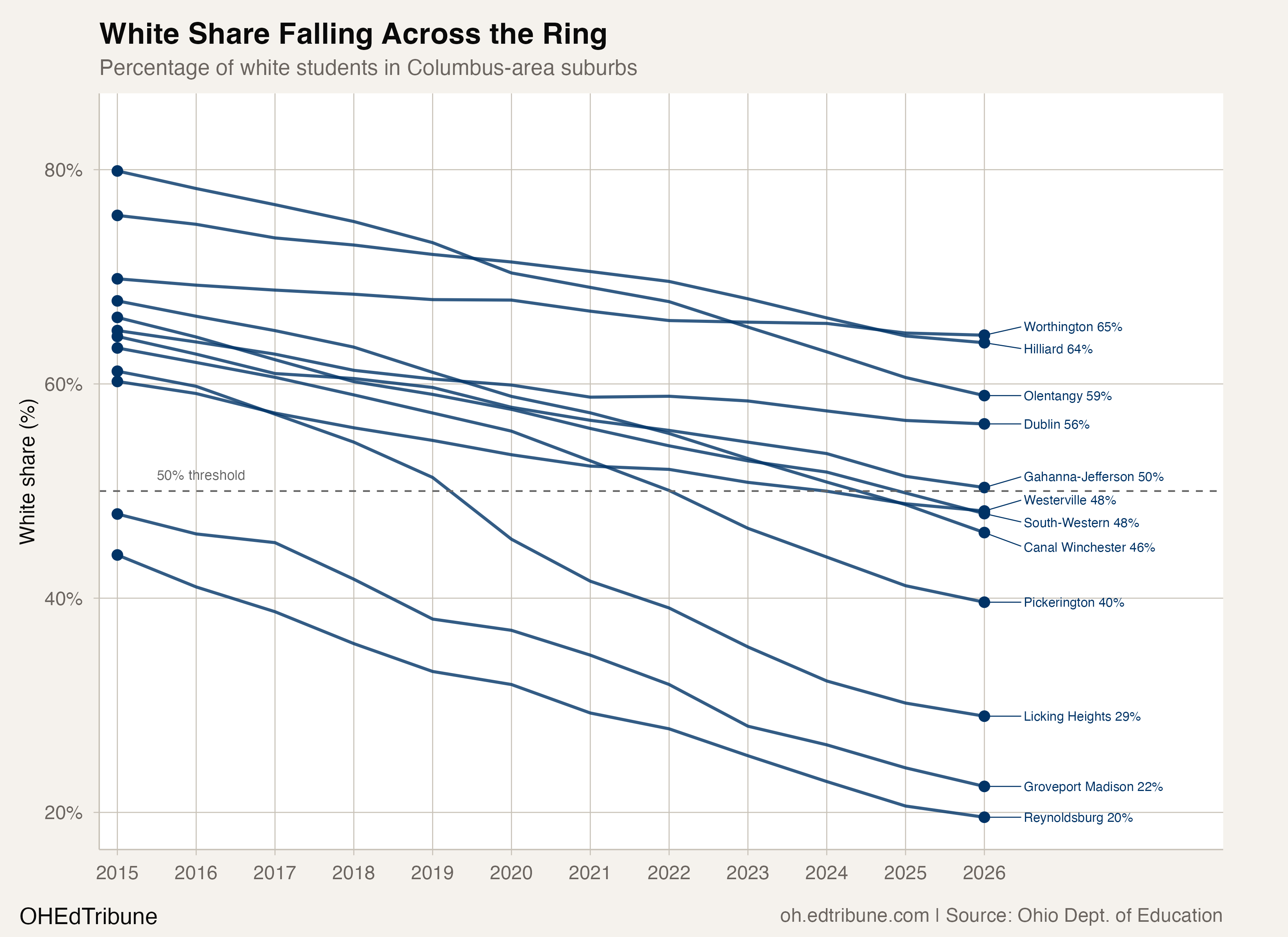
White enrollment share declined in every one of the 17 suburban districts between 2015 and 2026, without exception. Olentangy dropped from 79.9% to 58.9%. Hilliard City↗ET fell from 75.7% to 63.8%. Even Upper Arlington City↗ET, among the most affluent suburbs in Ohio, ticked down from 87.0% to 84.3%.
Licking Heights: the most striking transformation
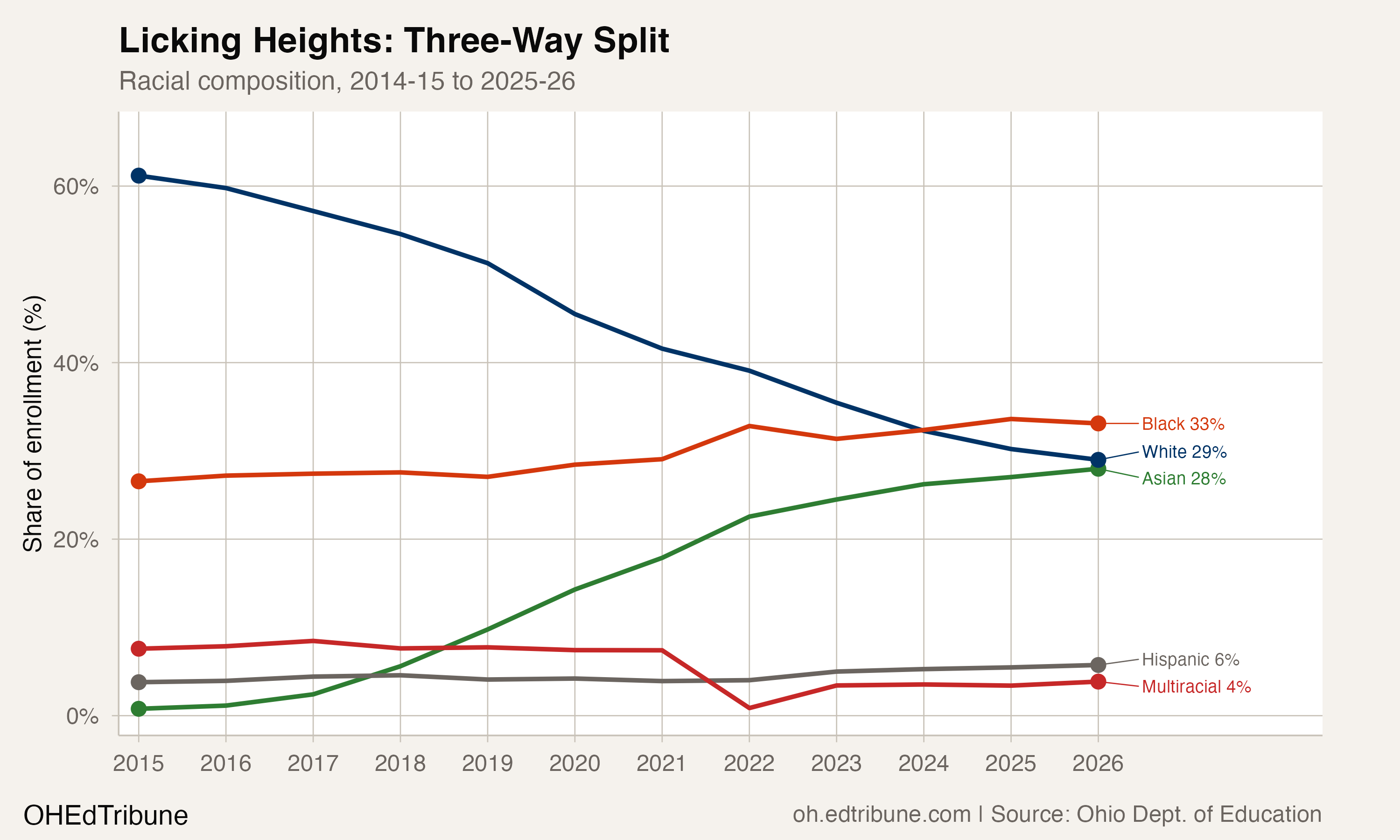
No district in the Columbus metro illustrates the demographic shift more vividly than Licking Heights. A decade ago, this was a small, predominantly white district east of the city, enrolling 3,849 students who were 61.2% white, 26.6% Black, and 0.8% Asian.
By 2026, Licking Heights enrolls 5,258 students split nearly three ways: 33.1% Black, 29.0% white, 28.0% Asian. The Asian share rose from 30 students in 2015 to 1,471 in 2026, a nearly fiftyfold increase. The district reports that its students now speak more than 47 languages.
Pataskala sits close to several of the Columbus region's largest technology employers. The district's own profile names Facebook, Google, Amazon, Amgen, and American Electric Power as companies that have expanded within district boundaries. Intel's semiconductor fabrication campus under construction in neighboring New Albany, originally a $20 billion investment later increased to $28 billion, is also nearby.
Olentangy's Asian enrollment tells a parallel story. The district's Asian student population nearly tripled, from 1,830 (9.6% share) in 2015 to 5,368 (22.0%) in 2026, an increase of 193.3%.
Two systems, one metro area
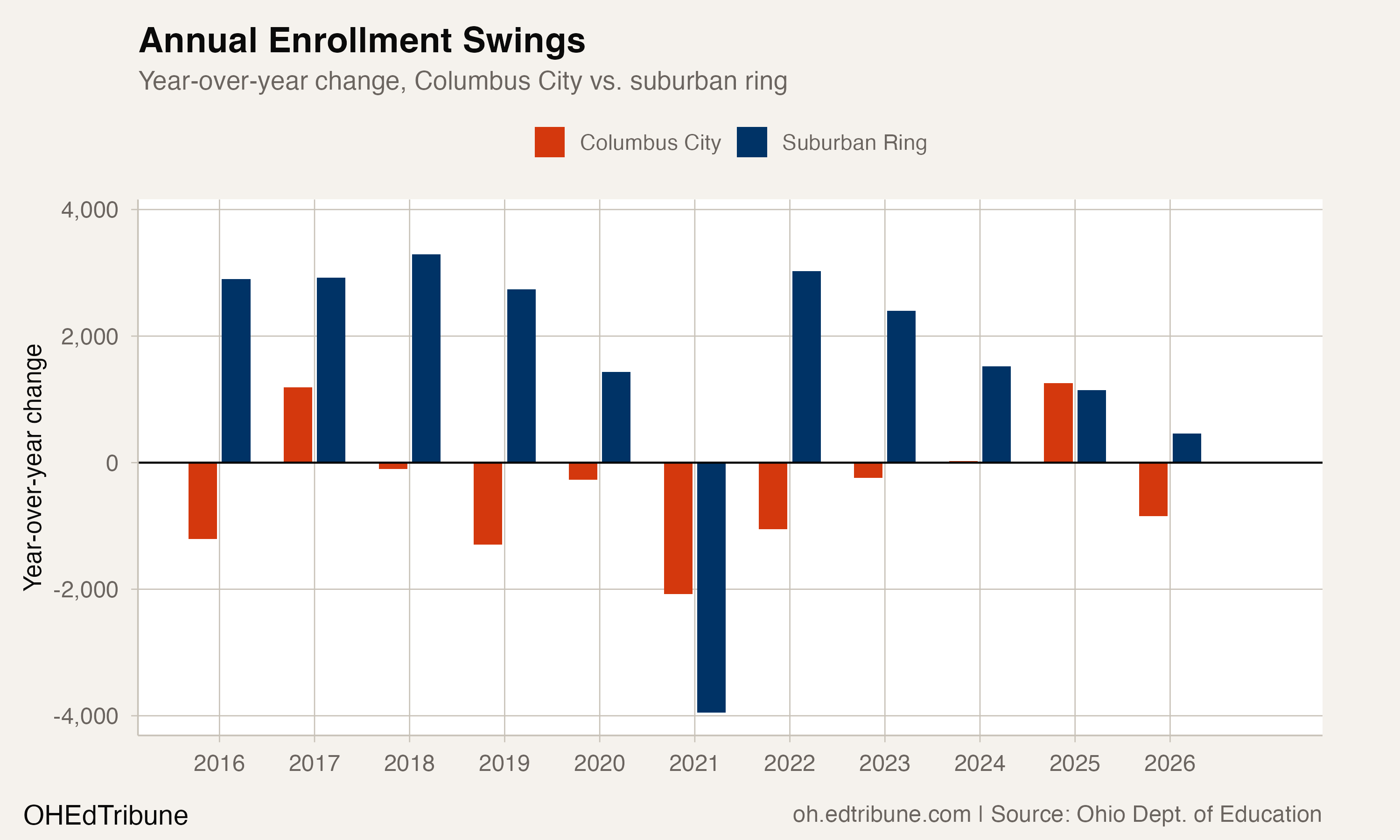
The year-over-year chart reveals a structural divergence that predates the pandemic and has persisted through it. In nearly every year from 2016 to 2026, Columbus City lost students while the suburban ring gained them. The only year the suburbs lost enrollment was 2021, when both city and ring were hit by COVID-era disruptions. The suburbs recovered fully by 2023; Columbus City did not.
Columbus City's demographic trajectory mirrors the enrollment decline. White enrollment dropped from 25.1% to 18.0% of the student body, a loss of 4,443 white students, 35.0%. Hispanic enrollment doubled from 4,924 (9.8%) to 9,207 (20.1%), adding 4,283 students. Black enrollment, the district's largest subgroup, fell from 28,046 (55.6%) to 23,452 (51.2%), a loss of 4,594 students that nearly matches the total enrollment decline.
Asian enrollment grew sharply in parts of the suburban ring while it shrank in the city. Between 2014-15 and 2025-26 it rose from 1,830 to 5,368 in Olentangy, from 30 to 1,471 in Licking Heights, and from 124 to 1,262 in Reynoldsburg, where Asian students went from 1.9% to 18.5% of the district. Columbus City's own Asian enrollment fell over the same years, from 1,678 to 1,285. District counts follow schools, not families, so they cannot say how many of the new suburban students left the city, moved from elsewhere in Ohio, or came from out of state.
Two planning problems, one metro
Olentangy Superintendent Todd Meyer has warned that without new facilities, the district will add portable classrooms to campuses, increase class sizes, and reduce extracurricular opportunities. The fifth high school, funded by a $235 million bond issue, is expected to open in fall 2028.
Twenty-five miles south, Columbus City has projected it will enter deficit spending without additional state funding or another levy. Superintendent Chapman has framed the school closures as an opportunity to consolidate students into "bigger, better neighborhood schools." But fifteen of the district's campuses already sit below 60% utilization.
One superintendent is trying to build fast enough. The other is trying to close fast enough. They share a metro area and a labor market, and for a decade the students have been adding up on one side of the city line and thinning out on the other.
Detailed code that reproduces the analysis and figures in this article is available exclusively to EdTribune subscribers.
Discussion
Sign in to join the discussion.
Loading comments...